On This Page8 sections
Quick Comparison
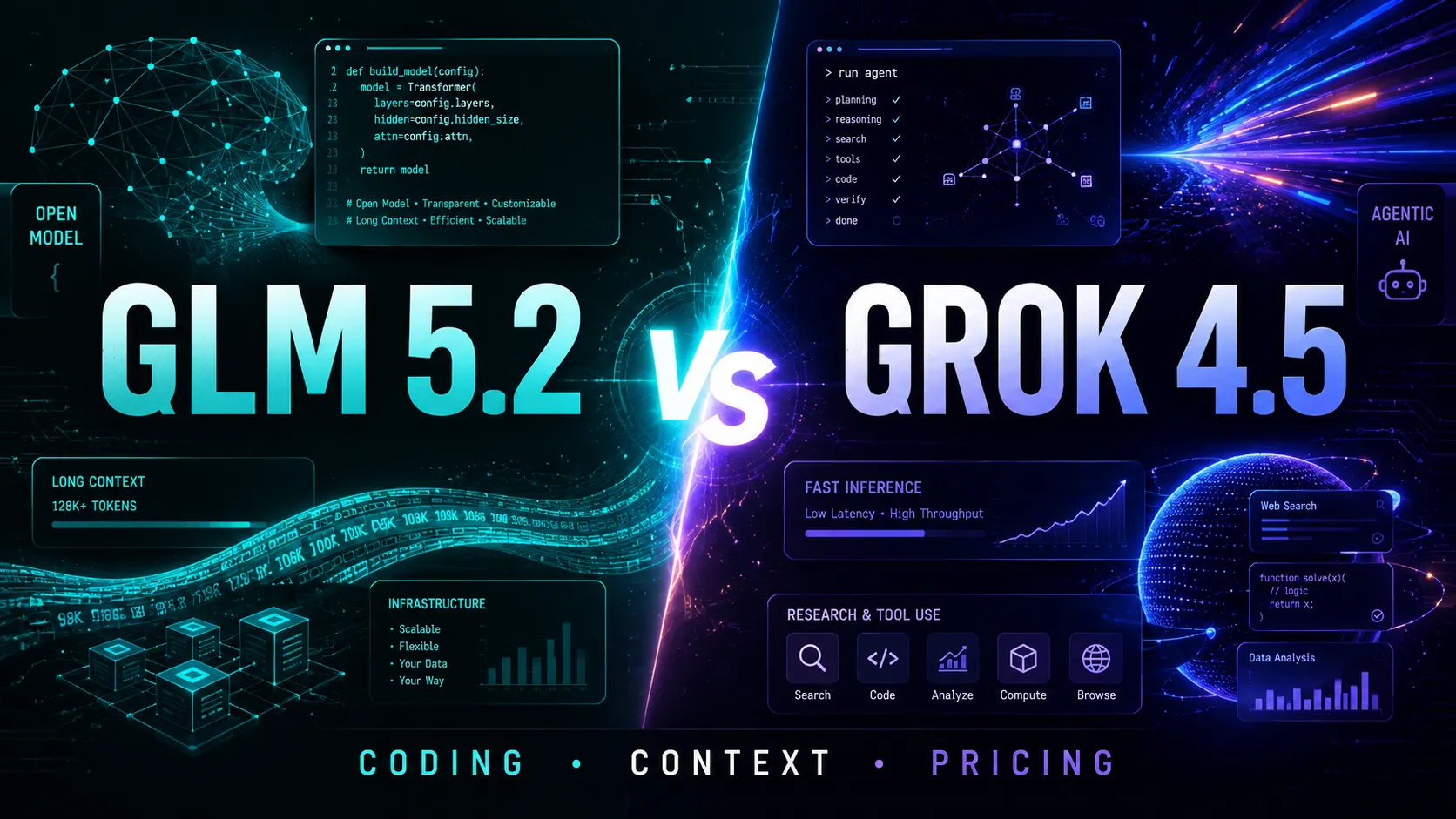
As of July 10, 2026, GLM 5.2 and Grok 4.5 are both frontier models aimed at demanding coding and agentic workloads, but they optimize for different constraints. GLM 5.2 emphasizes very long context, lower token pricing, open weights, and self-hosting. Grok 4.5 emphasizes stronger results on the overlapping coding benchmarks published at launch, faster hosted inference, image input, and tightly integrated web, X, code-execution, and productivity tools.
| Category | GLM 5.2 | Grok 4.5 |
|---|---|---|
| Developer | Z.ai | SpaceXAI |
| Primary positioning | Long-horizon engineering and open deployment | Coding, agentic tasks, and knowledge work |
| Input modalities | Text | Text and images |
| Output modality | Text | Text |
| Context window | 1,000,000 tokens | 500,000 tokens |
| Maximum published output | 128,000 tokens | Not stated on the public model page |
| Reasoning control | High, max, or disabled | Low, medium, or high |
| Standard input price | $1.40 per 1M tokens | $2.00 per 1M tokens |
| Cached input price | $0.26 per 1M tokens | $0.50 per 1M tokens |
| Output price | $4.40 per 1M tokens | $6.00 per 1M tokens |
| Open weights | Yes, including BF16 and FP8 releases | No |
| Self-hosting | vLLM, SGLang, Transformers, KTransformers, Unsloth and others | Not available |
| Published hosted speed | Not specified | 80 tokens per second |
| Native hosted tools | Function calling, structured output, web search, MCP | Function calling, web search, X search, code execution, file search and remote MCP |
| Best fit | Large repositories, private deployment, cost-sensitive long-context agents | High-throughput hosted agents, multimodal coding, live research and integrated productivity workflows |
The headline trade-off is straightforward: Grok 4.5 has the stronger published coding scores on the clearest overlapping evaluations, while GLM 5.2 offers twice the context window, lower standard token prices, a larger published output allowance, and downloadable weights.
Performance and Benchmark Results
The most useful comparison comes from benchmarks where both models appear in the same published chart. In the Grok 4.5 launch evaluation, Grok 4.5 scored 53% on DeepSWE 1.1, compared with 44% for GLM 5.2. On SWE-bench Pro, Grok 4.5 reached 64.7%, while GLM 5.2 reached 62.1%. That gives Grok a 9-point lead on DeepSWE 1.1 and a 2.6-point lead on SWE-bench Pro.
Terminal-oriented results are closer, but they are not perfectly apples-to-apples. Grok 4.5 reports 83.3% on Terminal-Bench 2.1. GLM 5.2 reports 81.0% with the Terminus-2 harness and 82.7% using its best reported harness. These figures suggest a small Grok advantage, but harness, tool configuration, time limits, and reasoning budgets can materially change agent benchmark results.
GLM 5.2 also reports strong general reasoning results, including 99.2 on AIME 2026, 91.2 on GPQA-Diamond, 40.5 on Humanity's Last Exam without tools, and 54.7 with tools. Grok 4.5's launch material does not publish the same full reasoning suite, so there is not enough official overlap to make a clean math-and-science ranking between the two models.
For practical selection, the coding evidence supports three conclusions:
- Grok 4.5 has the measurable edge on the overlapping software-engineering benchmarks published at launch.
- GLM 5.2 remains close on SWE-bench Pro and Terminal-Bench 2.1 rather than falling into a lower performance tier.
- Benchmark scores should be validated against a team's own repository, tools, tests, and retry policy before replacing a production model.
Coding and Agentic Engineering
Both models are designed for multi-step engineering rather than isolated code completion.
GLM 5.2 is explicitly optimized for project-scale codebase takeover, cross-file refactoring, API migration, repository generation, paper reproduction, performance optimization, and long-running tasks that must retain architecture rules over many steps. Its 1M-token window and 128K maximum output are especially relevant when an agent needs to keep source files, documentation, test logs, dependency graphs, and earlier decisions in one working context.
Grok 4.5 is positioned around coding, agentic tasks, and knowledge work. Its launch examples emphasize Rust, C, C++, front-end application generation, and end-to-end products created from a single prompt. It is also the default model in Grok Build.
The practical difference is less about whether either model can write code and more about the shape of the workload:
- For a very large monorepo or documentation-heavy migration, GLM 5.2's 1M context provides more room before retrieval, summarization, or compaction becomes necessary.
- For difficult issue resolution within a smaller context, Grok 4.5's higher DeepSWE and SWE-bench Pro results indicate a better first candidate.
- For long autonomous loops, both need external controls such as test gates, diff limits, rollback points, budget ceilings, and human review. A high benchmark score does not remove operational risk.
Context Window and Long-Task Stability
GLM 5.2 supports a 1,000,000-token context window, twice Grok 4.5's 500,000 tokens. GLM 5.2 also publishes a 128,000-token maximum output, which is unusually large for repository generation, extended reports, migration plans, and multi-file patch production.
A larger context window is not automatically better. Very long prompts increase prefill latency, token cost, retrieval noise, and the probability that irrelevant files influence the answer. The strongest GLM use case is not simply pasting one million tokens into every request; it is preserving more project state when the task genuinely requires it.
Grok 4.5's 500K window is still sufficient for many medium and large repositories. Prompt-cache routing and context compaction can also support longer agent loops. However, requests exceeding 200K tokens use different pricing, so teams planning near-limit workloads should confirm the current long-context rate rather than extrapolating from the standard $2/$6 pricing.
Choose based on actual prompt distributions:
- Below 100K tokens, benchmark quality, latency, and output efficiency will often matter more than maximum context.
- Between 200K and 500K, both models remain viable, but Grok's long-context pricing becomes part of the cost model.
- Above 500K, GLM 5.2 is the only one of the two that can accept the request without prior compaction or retrieval.
Reasoning, Multimodality, and Tool Use
GLM 5.2 is a text-input, text-output model. It supports configurable thinking, streaming, function calling, context caching, structured output, web search, and MCP integration. For image-aware workflows, Z.ai provides separate vision models and a Vision MCP server rather than making GLM 5.2 itself multimodal.
Grok 4.5 accepts text and image input and produces text output. Its hosted API supports configurable reasoning, function calling, structured outputs, web search, X search, code execution, file or collection search, and remote MCP tools. This makes it better suited to tasks such as debugging from screenshots, analyzing UI regressions, reading diagrams, or combining code changes with live web and X research without assembling as many external components.
The tool ecosystems also have different economic models. Z.ai lists built-in web search at $0.01 per use. Grok lists web search, X search, and code execution at $5 per 1,000 calls, with collection search at $2.50 per 1,000 calls and attachment search at $10 per 1,000 calls, in addition to token charges. Tool definitions and execution behavior differ, so per-call prices should not be treated as equivalent measures of total task cost.
Pricing and Cost Efficiency
At standard API rates, GLM 5.2 is cheaper across all published token categories:
| Price per 1M tokens | GLM 5.2 | Grok 4.5 | GLM discount versus Grok |
|---|---|---|---|
| Input | $1.40 | $2.00 | 30.0% |
| Cached input | $0.26 | $0.50 | 48.0% |
| Output | $4.40 | $6.00 | 26.7% |
These are list prices before tool calls, regional differences, long-context surcharges, subscription quotas, or promotional credits.
For a representative request containing 100,000 uncached input tokens and 20,000 output tokens, the estimated token cost is:
- GLM 5.2: $0.228
- Grok 4.5: $0.320
Under that workload, GLM 5.2 is approximately 28.8% cheaper. If the 100,000 input tokens are served from cache, the estimated totals become $0.114 for GLM 5.2 and $0.170 for Grok 4.5, making GLM about 32.9% cheaper.
Token price alone does not determine task price. Grok 4.5 may offset part of its higher per-token rate if it completes a task with fewer retries or fewer generated tokens. Grok reports 15,954 average output tokens per SWE-bench Pro task, about 4.2 times fewer than Claude Opus 4.8 in its evaluation, but it does not publish the equivalent GLM 5.2 output-token figure. Therefore, a direct GLM-versus-Grok task-cost comparison requires production traces rather than list prices alone.
Speed and Throughput
Grok 4.5 is reported to run at approximately 80 tokens per second. Its public model information also lists default limits of 150 requests per second and 50 million tokens per minute for supported regions, although actual account limits may differ.
Z.ai does not publish a directly comparable hosted tokens-per-second figure for GLM 5.2. That prevents a defensible vendor-spec latency ranking.
For self-hosted GLM 5.2, speed depends heavily on quantization, GPU or NPU topology, tensor parallelism, context length, speculative decoding, and the inference engine. The model is a 744B-parameter mixture-of-experts model with 40B active parameters, so running the official BF16 or FP8 weights is an infrastructure project rather than a typical single-GPU deployment.
Z.ai says its IndexShare architecture reduces per-token FLOPs by 2.9 times at 1M context and that its improved speculative-decoding layer raises acceptance length by up to 20%, but real throughput still depends on the deployment.
API and Developer Experience
GLM 5.2 can be called through Z.ai's API using its SDKs or an OpenAI-compatible interface. The GLM Coding Plan supports both OpenAI Chat Completions and Anthropic Messages protocols, which makes it relatively easy to connect GLM to Claude Code, OpenCode, Cursor, Cline, TRAE, and other supported coding clients.
Grok 4.5 supports the Responses API and Chat Completions API, plus function calling, structured output, prompt caching, and server-side tools. It is available as the default model in Grok Build and directly in Cursor, while supported gateways and platforms include OpenRouter, Vercel, Cloudflare, Snowflake, Databricks Mosaic, Azure AI Foundry, Oracle Cloud, and Vertex Model Garden.
Ease of adoption therefore depends on the existing stack:
- Existing Claude Code or OpenAI-compatible coding setup: GLM 5.2 can often be introduced by changing the endpoint, key, and model name.
- Cursor, Grok Build, Microsoft Office, or Grok server-side tools: Grok 4.5 has the more integrated path.
- Custom private inference: GLM 5.2 is the only option of the two because its weights are downloadable.
- Image-aware agent without a separate vision service: Grok 4.5 is simpler.
Openness, Self-Hosting, and Data Control
GLM 5.2's decisive architectural advantage is availability outside the vendor API. Z.ai publishes BF16 and FP8 weights and documents deployment through vLLM, SGLang, Transformers, KTransformers, Unsloth, and Ascend-compatible frameworks. This enables private-cloud deployment, custom inference optimization, controlled data residency, fine-tuning, and deeper observability.
The trade-off is infrastructure cost. A 744B-A40B model requires substantial accelerator memory, networking, storage, and operational expertise. Self-hosting is most rational when privacy, sovereignty, customization, sustained utilization, or vendor independence justifies the engineering overhead.
Grok 4.5 is a closed hosted model. Teams receive a simpler managed service, high published throughput, and integrated tools, but cannot inspect or deploy the model weights. That is a better operational fit for teams that value rapid adoption over model-level control.
Ecosystem and Knowledge Work
Grok 4.5 has the broader first-party productivity surface. It is integrated into Grok Build and is used in Word, PowerPoint, and Excel add-ins. Its product positioning highlights spreadsheet modeling, web research, multi-sheet formulas, native PowerPoint shapes, diagrams, and document writing.
GLM 5.2's ecosystem is more developer- and deployment-oriented. Its strongest differentiators are open weights, long-context engineering, compatibility with popular coding agents, MCP integration, and support for multiple inference frameworks. It can perform knowledge work, but the official product story is less tightly connected to mainstream office applications.
For research agents, Grok's native X search is uniquely relevant when social posts, breaking developments, developer discussions, or market sentiment are primary inputs. GLM can use web search and external MCP services, but it does not offer the same first-party X integration.
Benchmark Caveats
The benchmark tables are informative, not definitive.
First, many agent benchmarks are highly sensitive to the harness. Tool permissions, repository setup, timeout, retry count, context management, reasoning effort, and patch-validation logic can change the score. The differing Terminal-Bench figures reported for GLM 5.2 illustrate this sensitivity.
Second, most launch benchmarks are vendor-reported. Competing figures may come from developers' system cards, model cards, public leaderboards, or vendor-selected evaluation setups. This makes controlled third-party testing important.
Third, aggregate scores hide task distribution. A model can lead overall while underperforming on a team's dominant languages, frameworks, repository size, test environment, or tool API.
A production evaluation should measure:
- Issue-resolution rate on a private set of representative tasks
- Tests passed without human patching
- Total input, cached, reasoning, and output tokens
- Number of tool calls and retries
- Wall-clock completion time
- Invalid or risky file changes
- Reviewer acceptance rate
- Cost per accepted pull request
Which Should You Choose?
Choose GLM 5.2 when:
- Your prompts or working set can exceed 500K tokens.
- You need downloadable weights, private deployment, fine-tuning, or data-residency control.
- Standard API cost is a major constraint at high token volume.
- You want a published 128K output allowance for large generation tasks.
- Your workflow already uses Claude Code, OpenCode, Cline, or another configurable OpenAI- or Anthropic-compatible client.
- You are willing to trade a small-to-moderate benchmark gap for openness, context capacity, and lower list pricing.
Choose Grok 4.5 when:
- You want the stronger model on the overlapping DeepSWE 1.1 and SWE-bench Pro launch results.
- You need image input for UI debugging, screenshots, diagrams, or visual coding tasks.
- Fast hosted generation and a published 80-token-per-second service rate matter.
- Your agent benefits from first-party web search, X search, code execution, file search, or remote MCP.
- You use Cursor, Grok Build, or Office integrations.
- You prefer a managed platform and do not need access to model weights.
Run a controlled bake-off when:
- Your repository is under 500K tokens and both models meet the deployment requirements.
- A 2.6-point SWE-bench Pro difference may or may not translate into better results on your stack.
- Grok's higher token price could be offset by fewer retries, faster generation, or shorter outputs.
- GLM's larger context could reduce retrieval complexity but increase prompt size and prefill latency.
Final Assessment
Grok 4.5 is the stronger default for teams prioritizing hosted coding performance, speed, multimodal input, real-time research, and integrated agent tools. Its advantage is most visible in the shared launch benchmarks and in its product ecosystem.
GLM 5.2 is the stronger default for teams prioritizing one-million-token context, lower token pricing, large output capacity, open weights, self-hosting, and protocol flexibility. It remains close enough on major coding benchmarks to be a serious alternative rather than merely a budget model.
There is no universal winner. For a managed coding agent with live tools, Grok 4.5 has the clearer edge. For large-context engineering or controlled deployment, GLM 5.2 offers capabilities Grok 4.5 does not match.
Continue Reading
More articles connected to the same themes, protocols, and tools.
Referenced Tools
Browse entries that are adjacent to the topics covered in this article.