

Heroku
A mature platform as a service that prioritizes developer productivity by managing application builds, runtime infrastructure, delivery workflows, and common data services.
Information checked: Jul 13, 2026 ·View sources
Tool details
- Type
- Developer workflows
- Platforms
- Web, macOS, Linux, Windows, API
- Free plan
- No
- Open source
- No
- Bring your own key
- No
- Local models
- No
Overview
Best for
- Web applications and REST or GraphQL APIs
- Background workers and scheduled application processes
- Startups that want to minimize infrastructure administration
- Teams using GitHub pull requests and preview environments
- Ruby, Node.js, Python, Java, Go, PHP, Scala, Clojure, and .NET applications
- Applications that benefit from tightly integrated managed PostgreSQL
- Enterprises requiring a managed PaaS with isolated network environments
- Deploying AI application backends and agent services
Strengths
- Highly streamlined path from source code to a running application
- Mature buildpack and multi-language deployment ecosystem
- Strong pipelines, Review Apps, and pull-request workflows
- Managed Postgres integrates closely with applications and releases
- Supports source-based and Docker-based deployment
- Enterprise options add network isolation, governance, and compliance controls
- Large add-on marketplace reduces third-party service integration work
Limitations & trade-offs
- Projects requiring permanently free hosting
- Applications that depend on persistent local filesystems
- Teams requiring unrestricted Kubernetes or operating-system control
- Extremely cost-sensitive workloads with consistently high compute usage
- Workloads needing specialized hardware not offered by Heroku
- Complex multi-cloud infrastructure managed as low-level resources
- New projects that cannot use Private Spaces but specifically require the Fir generation
- No permanent free compute or database tier
- Costs can rise quickly across multiple Dynos, databases, and add-ons
- The Dyno filesystem is ephemeral and unsuitable for persistent uploads
- Basic Dynos cannot scale horizontally
- Native autoscaling is limited to selected higher-priced Dyno tiers
- The Fir generation currently requires Private Spaces and has migration considerations
- Provides less infrastructure-level control than direct cloud or Kubernetes platforms
Get started
Pricing & usage limits
Official pricingFrom $5
Provides 1,000 shared dyno hours for personal apps. Eco web dynos sleep after 30 minutes of inactivity.
Always-on 512MB dyno for small applications that do not require horizontal scaling.
Production dynos with horizontal scaling, application metrics, Preboot, and unlimited process types.
Dedicated compute for high-traffic applications, predictable performance, and native autoscaling.
Dedicated next-generation Dynos using Cloud Native Buildpacks; currently require a Fir Private Space.
Managed PostgreSQL starts with the Essential-0 plan, including 1GB of storage and 20 connections.
Adds centralized governance, Dyno Units, Private Spaces, advanced permissions, audit trails, and enterprise support.
Pricing checked: Jul 13, 2026 · Subscription, usage limits, and model costs may be billed separately.
Features & details
Build and Deploy
- Git, GitHub, Docker, API, and Terraform deployment
- Automatic language detection with buildpacks
- Cloud Native Buildpacks on the Fir generation
- Procfile-based web and worker processes
- Config vars, release commands, and release rollback
Delivery Workflow
- Staging and production pipelines
- Disposable Review Apps for pull requests
- Heroku CI test environments
- GitHub automatic deployment
- Preboot and zero-downtime release options
Runtime and Data
- Horizontally and vertically scalable Dynos
- Manual and automatic web-process scaling
- Managed PostgreSQL and key-value storage
- Apache Kafka and third-party add-ons
- Unified logs, metrics, alerts, and health checks
Enterprise and AI
- Private and Shield Private Spaces
- SAML single sign-on and per-app permissions
- Enterprise audit trails and usage reporting
- Managed Inference and Agents
- Model Context Protocol integrations
Why Choose Heroku?
Heroku is most valuable when engineering time is more expensive than infrastructure abstraction. It packages application builds, process management, routing, certificates, runtime patching, logging, releases, and many operational tasks into a consistent platform workflow.
This lets a small team deploy a production application without first designing a virtual network, configuring a load balancer, maintaining base images, operating a container cluster, or building a custom deployment system. The tradeoff is reduced control over the underlying infrastructure and a higher unit cost than many raw compute services.
Heroku's process model is also unusually durable. Web servers, background workers, schedulers, migrations, and one-off administrative jobs follow the same release and configuration system. This reduces the number of separate operational patterns a team must maintain as an application grows.
The platform is not an AI IDE or coding agent. Its role in an AI development stack is to host model-enabled APIs, retrieval services, agent backends, asynchronous workers, MCP-connected tools, and other applications produced by coding assistants.
Core Workflow
A standard Heroku deployment begins with application source code and a dependency manifest. Heroku detects the language, selects the appropriate buildpack, installs dependencies, creates a deployable artifact, and launches the processes declared by the application.
Applications can also be shipped as Docker images. This is useful when the runtime requires operating-system packages, a custom build sequence, or closer parity with an existing container workflow. Source-based deployment remains simpler when the officially supported buildpacks already cover the application's requirements.
Runtime configuration is kept outside the repository through config vars. Each deployment combines a build artifact with the current configuration to produce an immutable release. Teams can therefore change credentials, feature flags, or external service endpoints without modifying source code, although changing config vars creates a new release and normally restarts the application.
The Procfile separates the application into process types. A typical system may use a web process for HTTP traffic, one or more worker processes for queues, a scheduler for periodic work, and a release process for database migrations. Each process type can be scaled independently.
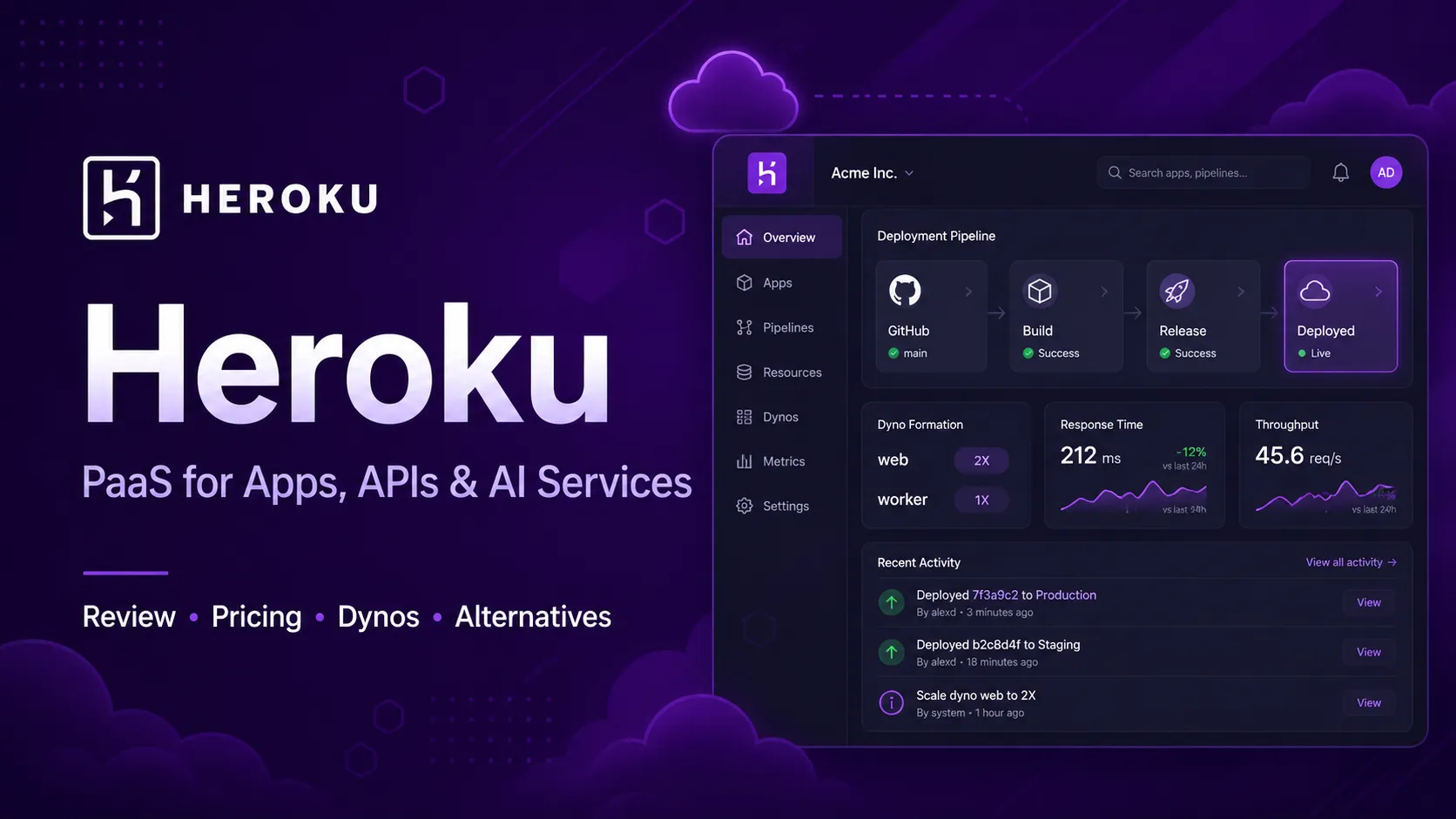
For GitHub-based teams, Heroku Pipelines connect development, staging, and production applications. Review Apps can create a disposable environment for every pull request, while Heroku CI executes tests in an environment that closely resembles the deployed runtime. Review Apps and CI resources are billed like other temporary Heroku resources, so automatic cleanup policies are important.
Use Cases
Heroku remains well suited to conventional web products where the application team wants to own code and architecture but not the surrounding container platform. SaaS applications, internal services, REST APIs, GraphQL APIs, webhook processors, administration systems, and backend services fit naturally into its process model.
Background processing is a particularly strong use case. Web traffic and queue consumers can run as separate process types using the same source release and configuration. Teams can scale worker capacity independently without creating another deployment environment.
Heroku is also practical for development agencies and consulting teams that operate many client applications. The shared deployment model reduces the operational differences between projects, while pipelines and app-level collaboration make it easier to manage access and releases.
For AI applications, Heroku can host chat backends, retrieval-augmented generation services, orchestration APIs, tool servers, evaluation jobs, and asynchronous document-processing workers. Heroku Managed Inference and Agents provides a more integrated route to supported model and agent capabilities, while MCP support enables tool-oriented workflows.
Heroku is less suitable when the application requires persistent local disks, privileged containers, custom kernel behavior, specialized accelerators, unrestricted Kubernetes resources, or detailed control over networking and instance placement.
Where Fir Fits
Fir is Heroku's next-generation platform and uses cloud-native technologies, including Cloud Native Buildpacks and a Kubernetes-based runtime. It provides more explicit CPU and memory configurations, dedicated compute, in-region builds and telemetry, and a modern foundation for future platform development.
As of the verification date, Fir Dynos require a Fir-generation Private Space. This makes Fir most immediately relevant to organizations already evaluating private networking or enterprise-level deployment rather than low-cost personal applications in the Common Runtime.
Cedar and Fir do not use identical build systems. Cedar applications generally use classic Heroku buildpacks, while Fir applications use Cloud Native Buildpacks. Custom classic buildpacks, add-ons, networking assumptions, observability tools, and release behavior should be checked before migration.
Heroku recommends Fir for new and actively developed projects where it is available, but Cedar remains supported. Teams should evaluate actual feature parity rather than treating the migration as a simple stack upgrade.
Comparison to Alternatives
Render follows a familiar managed-service model and supports web services, workers, scheduled jobs, databases, and preview environments. It can feel more modern and cost-accessible for new projects, while Heroku provides a longer-established ecosystem, mature release model, and deeper enterprise history.
Railway offers a highly visual developer experience with usage-based infrastructure and easy deployment of related services. It is attractive for prototypes and small teams, while Heroku provides more formal pipelines, application lifecycle conventions, and enterprise governance.
Fly.io exposes more infrastructure behavior through globally distributed Machines and private networks. It is preferable when geographic placement and machine lifecycle are product-level requirements. Heroku is simpler when the team wants to reason primarily about application processes rather than virtual machines.
Northflank combines container deployment, environments, jobs, databases, and delivery automation. It provides more container-oriented orchestration options, while Heroku offers a more opinionated process model and a larger legacy ecosystem of buildpacks and add-ons.
Google Cloud Run is a strong alternative for stateless, request-driven containers that should scale toward zero. It integrates deeply with Google Cloud but requires teams to assemble more of the surrounding database, networking, access, and delivery architecture themselves.
DigitalOcean App Platform provides managed source and container deployments within the DigitalOcean ecosystem. It can be cost-effective for straightforward workloads, while Heroku offers more mature workflow conventions and enterprise deployment options.
Best Configuration
A production application should be designed as a stateless set of processes. Files written inside a Dyno disappear when the Dyno restarts or is replaced, and they are not shared with other Dynos. User uploads and generated assets should therefore be sent to object storage rather than stored on the local filesystem.
The web process should start quickly, bind to the port supplied through the environment, respond to termination signals, and avoid keeping essential state in memory. Long-running work should be moved to a queue-backed worker instead of blocking an HTTP request.
Use a release process for database migrations, schema checks, and other tasks that must complete before new code reaches the running formation. A failed release command prevents the new build from being deployed, reducing the risk of releasing code against an incompatible database schema.
Keep separate applications for development, staging, and production. Promote the same compiled release through a Pipeline instead of rebuilding independently for every environment. This reduces differences caused by dependency resolution or build-time changes.
For reliable production deployments:
- Pin language and dependency versions explicitly.
- Use maintained official buildpacks where possible.
- Send application logs to standard output and standard error.
- Store secrets in config vars or an approved external secret manager.
- Configure application and database monitoring before launch.
- Run at least two web Dynos when availability matters.
- Test database migrations against a recent production-like copy.
- Enable Preboot only after confirming that old and new releases can overlap safely.
- Delete stale Review Apps and unused add-ons automatically.
- Track Dyno, database, CI, Review App, and add-on costs together.
Managed Postgres plan selection should be based on downtime tolerance, storage, connection count, memory, replication, rollback, and high-availability requirements rather than database size alone. Essential plans are appropriate for small, interruption-tolerant projects, while production systems may require Advanced, Premium, Private, or Shield capabilities.
Migration Notes
Moving to Heroku usually requires adapting the application to a stateless, environment-configured process model. Local filesystem uploads, hard-coded ports, background work inside web requests, manually managed environment files, and server-specific cron tasks should be redesigned before deployment.
Applications coming from a traditional VPS should separate runtime configuration from source code, stream logs instead of writing permanent log files, move scheduled tasks into a scheduler or worker, and send persistent data to external services.
Docker-based migrations can preserve more of the existing build environment, but Heroku still controls runtime behavior. Images must satisfy Heroku's container requirements, listen on the assigned port, avoid relying on persistent container storage, and support the architecture accepted by the Container Registry.
Teams moving from Cedar to Fir should inventory buildpacks, stack packages, add-ons, DNS behavior, private networking, metrics, log drains, release commands, and CI integrations. A Fir migration should be validated in a separate application or space before changing production traffic.
Heroku-22 is deprecated and is scheduled to reach end of life on April 30, 2027. Applications still using that stack should test Heroku-24 or Heroku-26 early, especially when they depend on native packages, binary libraries, headless browsers, image-processing tools, or custom buildpacks.
Moving away from Heroku is usually straightforward at the code level when the application follows Twelve-Factor principles, but managed service dependencies still require planning. Database backups, add-on data, config vars, domains, certificates, scheduled jobs, log drains, pipeline settings, and buildpack behavior must be recreated on the destination platform.
The most portable Heroku architecture keeps application code independent from proprietary add-on APIs, uses standard PostgreSQL or Redis-compatible clients, stores files in a dedicated object service, and documents every external dependency outside the Dashboard.
Model support & data privacy
Privacy & data handling
Heroku is a hosted platform operated by Salesforce, so application code, configuration metadata, logs, network traffic, and data stored in Heroku services can be processed on its infrastructure. Heroku provides encryption, access controls, Private Spaces, Shield services, and compliance documentation, but customers remain responsible for application security, dependency management, secret handling, data classification, user permissions, backups, and correct service configuration.
Guides, reviews & fixes
View allNo published guides yet. Start with the official documentation above.
Product updates
No verified product updates listed yet. Follow this tool to see new relevant content in Saved.
See the content timelineAlternatives
Sources & verification
Verification dates record when this directory checked the information. Product release dates appear separately above.
Directory revision history
Verified current Dyno and database pricing, Fir availability, supported languages, delivery workflow, enterprise controls, and Heroku AI positioning.
Heroku added Node.js 26.5.0 to the versions available for application builds.
Heroku updated the Heroku-22, Heroku-24, and Heroku-26 stack images with upstream security and package fixes.
The Ubuntu 26.04-based Heroku-26 stack became generally available with planned support through April 2031.
Heroku-22 was marked deprecated and scheduled to reach end of life on April 30, 2027.
Heroku Postgres Advanced entered limited general availability with decoupled compute and storage, greater scalability, and follower pools.
Fir, Heroku's next-generation cloud-native platform, became generally available through Fir Private Spaces.