On This Page8 sections
Key Takeaways
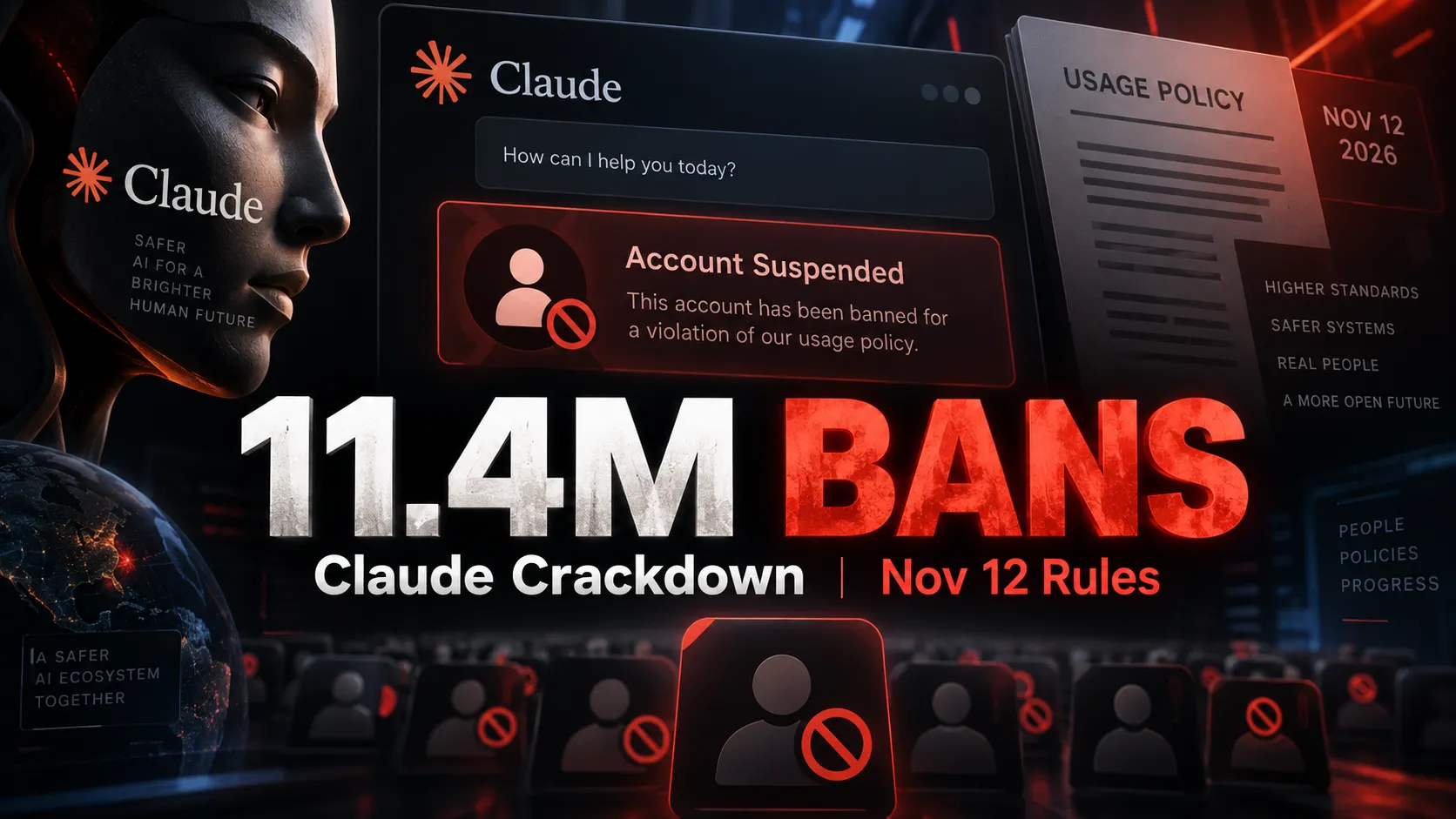
- Anthropic reported 11.4 million banned accounts between January and June 2026, alongside 398,000 appeals and 42,000 appeal overturns. These figures come from its Transparency Hub, last updated July 23, 2026; they are not a new October ban count.
- The indicative appeal-overturn rate is 10.55%, calculated as 42,000 divided by 398,000. The often-repeated 0.37% figure divides overturns by all banned accounts, not by appeals, and is not the appeal success rate.
- Anthropic's updated Usage Policy takes effect November 12, 2026, but restrictions on unsupported regions and foreign-controlled companies existed before that date. The October update clarifies their reach; it does not establish a scheduled mass-ban event.
- Location, incorporation, headquarters, and ownership or control can all matter. The Supported Regions Policy applies to Claude.ai, Claude Code, the Anthropic API, cloud-provider integrations, and authorized resellers.
- Developers should verify regional eligibility, keep independent backups, avoid unauthorized subscription proxies, and maintain a compliant provider-switching plan rather than treating an overseas IP address or company registration as a workaround.
Did Anthropic Really Ban 11.4 Million Claude Accounts?
Yes. According to Anthropic's official enforcement disclosures, 11.4 million accounts were banned in the first half of 2026. In the same reporting window, Anthropic recorded 398,000 appeals and 42,000 appeal overturns. The figures were published in July and drew renewed attention after a widely circulated X post connected them to the October policy announcement.
The distinction between accounts and people is essential. An account total does not reveal how many unique individuals, paying subscribers, or legitimate developers were affected. Anthropic has not published a full breakdown by geography, violation type, bot-versus-human status, or active user base. Without those denominators, no reliable probability of an ordinary paid customer being banned can be calculated.
How Enforcement Changed from 2025 to 2026
| Reporting period | Banned accounts | Appeals | Overturned appeals | Overturns / appeals |
|---|---|---|---|---|
| Jan–Jun 2025 | 690,000 | 35,000 | 1,000 | 2.86% |
| Jul–Dec 2025 | 1,450,000 | 52,000 | 1,700 | 3.27% |
| Jan–Jun 2026 | 11,400,000 | 398,000 | 42,000 | 10.55% |
The 2025 figures appear in Anthropic's first-half 2025 report and second-half 2025 report. The latest half-year count is about 7.9 times the preceding six months and 16.5 times the same period in 2025. These changes measure enforcement volume, not the personal risk faced by every Claude customer.
Another mathematical trap is treating 42,000 divided by 11.4 million, or approximately 0.37%, as the chance that an appeal succeeds. It is merely the number of overturns as a fraction of all banned accounts. The more relevant appeal-based calculation is 42,000 divided by 398,000, equaling 10.55%. Because the reports give aggregate counts rather than individual appeal histories, even this should be described as an indicative overturn ratio, not a guaranteed individual outcome.
Why Are So Many Claude Accounts Being Banned?
Anthropic says its Safeguards team enforces its Usage Policy, terms of service, and regional-access rules. Possible actions include warnings, throttling, suspension, and termination. Reasons for a ban can include repeated policy violations, unsupported-location registrations, and other terms violations, as explained in the official appeals guidance.
Large-scale abuse is one relevant context, but it should not be presented as the proven explanation for the entire 11.4-million total. In a February 2026 report on illicit model distillation, Anthropic described campaigns involving approximately 24,000 fraudulent accounts and more than 16 million model exchanges. It also reported a proxy network capable of managing over 20,000 fraudulent accounts simultaneously. That illustrates how automated account networks can inflate enforcement counts, but Anthropic has not attributed a stated percentage of the half-year bans to those campaigns.
Its September 2026 threat-intelligence report further explains that suspected unauthorized resale, unsupported-region activity, and illicit distillation may trigger identity checks. Accounts failing required verification may be banned. Detection mechanisms are not fully public, and ordinary users should not assume that any one VPN, payment method, or coding task automatically causes termination.
What Changes on November 12, 2026?
Anthropic announced its 2026 Usage Policy update on October 8. The new Usage Policy is scheduled to take effect on November 12, 2026. The company says most revisions clarify existing restrictions rather than create entirely new categories of prohibited conduct.
The changes extend beyond geography:
- Deceptive activity: More explicit restrictions cover fake accounts, misleadingly independent websites, artificial amplification, and efforts to manipulate the sources that search engines or AI assistants rely on.
- Elections: Rules focus on deception, impersonation, voter suppression, and disruption. Anthropic also removed its prior blanket restriction on personalized campaign targeting, while deceptive or privacy-invasive uses remain prohibited.
- Surveillance and weapons: The updated text more clearly covers nonconsensual tracking, surveillance tooling, weapons-related software, and autonomous weapons integration.
- High-risk decisions: Certain medical, financial, legal, employment, and similar recommendations require appropriate qualified human review and disclosure to affected people.
- Autonomous physical systems: Hardware able to take high-risk physical actions needs meaningful human override and independent safety limits.
- Abuse of Claude itself: Sustained, gratuitous cruelty toward the model is prohibited. Anthropic explicitly distinguishes this from normal frustration, legitimate testing, critical feedback, and dark fictional content.
- Platform abuse: The policy text explicitly addresses ban evasion, coordinated malicious multi-account activity, and unauthorized resale or proxy access, including routing requests through consumer subscriptions.
The crucial timing distinction is that November 12 is not an official announcement of a fresh 11.4-million-account purge. Regional restrictions were already in force, including an ownership-related expansion announced in September 2025. Claims that a new mass-ban wave is certain on November 12 remain speculation.
Claude's Supported Regions Policy: The Five Eligibility Tests
The current official regional policy describes several overlapping exclusions. Access may be prohibited when:
- A person is physically located in an unsupported region while using Claude, even if employed by a company based elsewhere.
- An entity is incorporated in an unsupported region, even when employees access Claude from supported locations.
- An entity is headquartered in an unsupported region, regardless of where its technical infrastructure sits.
- An entity is majority-owned, directly or indirectly, by people or entities in unsupported regions. Ownership chains can matter more than the immediate jurisdiction of the operating subsidiary.
- An entity is controlled, directly or indirectly, by such people or entities. The control criterion should not be assumed to disappear simply because formal equity ownership falls below a majority.
This is a location-and-control policy, not an explicit nationality-only test. A person's passport, by itself, is not identified as the deciding criterion in the published regional wording. Conversely, a US billing address, US server, or US-incorporated company does not automatically satisfy the rules.
In its September 4, 2025 announcement, Anthropic specifically described entities more than 50% owned directly or indirectly by companies headquartered in unsupported regions. The October 2026 clarification also expressly addresses control by persons or entities. Complex shareholding and governance cases may require direct clarification from Anthropic and professional legal review.
Which Locations Are Supported?
The current public list includes Taiwan, the United States, the United Kingdom, Singapore, and Japan. Mainland China, Hong Kong, and Macau are not listed. Anthropic states that any location absent from the official list is unsupported. Consult the live country list before making business or travel decisions because eligibility can change.
Practical Cross-Border Examples
| Scenario | Policy implication |
|---|---|
| A person uses Claude while physically in mainland China through a US VPN | An apparent US IP does not change the person's actual location; unsupported-region use remains prohibited. |
| A Hong Kong-incorporated company has employees in Singapore | The incorporation criterion still creates a regional-policy restriction for that entity. |
| A US LLC is majority-owned or controlled by people located in unsupported regions | US incorporation alone does not make the entity eligible. |
| An employee of an otherwise eligible UK company uses Claude during a trip to Hong Kong | The individual's actual location is independently relevant. |
| A Taiwan-based entity with eligible ownership and staff using Claude in supported regions | Its regional facts are generally consistent with the published list, subject to the full policy and applicable terms. |
| A Chinese passport holder lawfully lives and works in Japan | Nationality alone is not the published regional test; actual use, organizational links, and control still matter. |
These examples illustrate policy wording rather than determine a particular business's contractual or legal status.
Does the Restriction Cover Claude Code, Bedrock, Vertex AI, and API Resellers?
Yes, the regional policy's stated scope is broad. It names Claude.ai, Claude Code, Cowork, the Anthropic API, developer services, and Claude models distributed through cloud platforms or authorized resellers. The updated Usage Policy also says its conduct rules extend to developers, cloud-provider customers, and end users of services integrating Claude.
Using a cloud intermediary does not automatically exempt a user or customer from Anthropic's stated regional rules. However, AWS, Google Cloud, and reseller-specific access arrangements may have separate contracts and enforcement procedures; the public policy alone does not establish how or when every provider will suspend an account.
For SaaS companies, a more careful review distinguishes the contracting entity, the actual people operating the system, and end-user access. A legally authorized integration must be evaluated across these layers. Hosting an API gateway in the US is not, on its own, an answer to ownership or end-user eligibility requirements.
How Does Anthropic Detect Unsupported-Region Access?
Anthropic's location privacy guidance says it uses IP addresses and other signals to infer country- or region-level location for anti-abuse and terms-compliance purposes. That mandatory security use of location information cannot be disabled via optional product-personalization controls.
IP geolocation can be imperfect, and the company does not disclose its full enforcement model. Therefore:
- A VPN connection is not publicly documented as an automatic ban trigger in every circumstance.
- A VPN also does not make use from an unsupported physical location compliant.
- A suspicious-location flag does not, by itself, establish wrongdoing; it may need further investigation.
- An identity-verification request should be handled through the official process rather than through replacement accounts or third-party account sellers.
Community experiences provide context, not proof of systemic error. In an October 2026 GitHub issue, a paid user described a location-policy suspension despite claiming residence in the United States; the report remained an individual allegation, not independently verified evidence of a false positive. A separate Reddit discussion described a claimed suspension from the Philippines, which is on Anthropic's supported list. Neither account establishes the undisclosed cause of its suspension.
What to Do if Your Claude Account Is Suspended
Anthropic's appeal instructions provide the appropriate route:
- Sign in at Claude with the affected account, even if access has been suspended.
- Use the official appeal form shown on the restricted-account screen. Anthropic states that the user must be logged in to access it.
- Supply concise, accurate context: the suspension notice, relevant dates, actual location history, business entity details where relevant, and any identity-verification problems. Avoid guessing the reason or submitting contradictory explanations.
- If an organization is on hold while the individual's account remains in good standing, use the separate Request a review option for the affected organization.
- Check whether the account interface still permits data export. Anthropic says banned Free, Pro, and Max customers may be able to self-export data, but accessible material can be restricted based on the violation category.
Do not assume an appeal will be approved, that it will be processed within a guaranteed time, or that creating a second account is an acceptable fallback. Anthropic's upcoming Usage Policy expressly prohibits circumventing a ban through another account.
How Developers Can Reduce Business Risk Before a Suspension
The strongest response is operational resilience, not a workaround for region controls. For teams depending on Claude Code or the API, the following measures protect legitimate workflows:
- Review eligibility: Record the country of incorporation, headquarters, controlling parties, operational users, and relevant customer markets. Recheck the official supported-regions list as it changes.
- Keep project assets portable: Store source code, prompts, configuration files, skills, architecture decisions, and documentation in repositories and storage controlled by the business. Export valuable chat content when available.
- Separate provider dependencies: Implement a vendor-neutral service boundary so supported workloads can be moved to another appropriately authorized model provider without rewriting the product.
- Classify failures correctly: Distinguish transient outages and rate limits from payment, identity, terms, and region denials. Do not disguise policy-related errors as ordinary network retries or automatically switch to unauthorized Claude accounts.
- Check reseller provenance: Verify whether API access is directly authorized for the intended users and geography; consumer-subscription proxying is expressly prohibited in the forthcoming policy.
- Maintain continuity procedures: Prepare test prompts, evaluation sets, feature flags, incident ownership, and a documented alternative provider for critical customer-facing functions.
A simple technical boundary makes replacement less disruptive:
Product / Agent / Coding Workflow
              |
     Internal LLM Adapter
         /         \
Approved Provider A   Approved Provider B
              |
       Logs + Evaluation
Both providers must independently be eligible for the users and jurisdictions involved. Model substitution is a reliability practice, not a way to evade the original provider's rules.
Frequently Asked Questions
Is Claude Banning All Chinese Users?
The public regional policy does not impose a blanket ban solely by nationality. It focuses on unsupported physical locations and entities' incorporation, headquarters, majority ownership, and control. Those conditions can affect internationally incorporated companies and remote teams.
Will Every Claude Account Be Banned on November 12, 2026?
No such event has been announced. November 12 is the effective date of the updated Usage Policy. The 11.4-million-account figure covers January–June 2026 and was disclosed in July.
What Percentage of Claude Appeals Are Successful?
Using published aggregate figures for the first half of 2026, 42,000 / 398,000 ≈ 10.55%. This is an indicative overturns-to-appeals ratio, not a guarantee for a particular suspension. 0.37% instead compares overturned appeals with all banned accounts and should not be labeled the appeal success rate.
Can Developers Use Claude Through AWS or a Third-Party API in Unsupported Regions?
The regional policy expressly covers cloud-provider and authorized-reseller offerings. An intermediary does not automatically confer regional eligibility. Contract-specific questions should be reviewed with the relevant provider and Anthropic.
Is Criticizing Claude Now Against Policy?
No. Anthropic describes its model-abuse restriction as targeting sustained and needless abusive conduct, not ordinary frustration, criticism, creative content, or legitimate research and testing.
Conclusion
Anthropic's 11.4 million bans are confirmed, but predictions of an inevitable November 2026 mass-ban wave are not. The enforcement data show extraordinary scale without revealing what proportion of accounts were fraudulent, where banned accounts were located, or how frequently legitimate subscribers were affected. Meanwhile, Anthropic's regional policy makes location, incorporation, ownership, and control relevant across Claude's consumer, coding, and API products.
For businesses and developers, the next step is concrete: review eligibility against the official supported-regions list, read the November 12 Usage Policy, back up critical work, and establish an authorized provider fallback before access becomes business-critical.
Continue Reading
More articles connected to the same themes, protocols, and tools.


Referenced Tools
Browse entries that are adjacent to the topics covered in this article.