
 OpenRouterA unified model-routing API for multi-model coding agents and AI applications.
APIMart
APIMart is an OpenAI-compatible aggregation and routing layer for teams that want one API, balance, and monitoring surface across language, image, video, and audio models.
Information checked: Aug 29, 2026 ·View sources
Tool details
- Type
- Developer workflows
- Platforms
- Web, REST API, Python, Node.js, Java, OpenAI SDKs, Coding agents
- Free plan
- No
- Open source
- No
- Bring your own key
- No
- Local models
- No
Overview
Best for
- Independent developers building multi-model AI products.
- AI SaaS teams integrating several image and video providers.
- Applications that want OpenAI-compatible model switching and shared billing.
- Coding-agent workflows that use machine-readable llms.txt documentation.
- Prototypes and products that expect their preferred models to change frequently.
Strengths
- One integration covers language, image, video, and audio model families.
- OpenAI-compatible configuration can reduce migration work for existing applications.
- Shared billing and monitoring simplify multi-provider operations.
- The llms.txt index is useful for Cursor, Claude Code, Codex, and other coding agents.
- Routing and failover can reduce dependence on a single provider channel when supported.
Limitations & trade-offs
- Organizations that require a direct contract with every model provider.
- Local-only, offline, or self-hosted inference.
- Regulated workloads without an approved gateway data-processing review.
- Teams that need to deploy custom model weights on controlled GPU infrastructure.
- APIMart adds another data, credential, billing, and contractual layer between an application and model providers.
- Catalog availability, names, routes, and pricing can change as underlying providers change.
- The 500+ model count, savings claims, and 99.9% SLA are APIMart claims that buyers should verify for their workload.
- Image and video endpoints still require model-specific formats and production testing.
- Provider licensing, retention, regional availability, and safety behavior remain model-specific.
Get started
Pricing & usage limits
Official pricingSee pricing
Pay as you goUsage-based
No subscription is required. Rates vary by model and are charged per token, image, video duration, or other endpoint-specific unit.
EnterpriseCustom
Volume discounts, dedicated quotas, support, data-processing terms, and APIMart's advertised 99.9% enterprise SLA are available by arrangement.
Pricing checked: Aug 29, 2026 · Subscription, usage limits, and model costs may be billed separately.
Features & details
Unified AI API gateway
- One account, API key, shared balance, and usage console
- OpenAI-compatible base URL for supported endpoints
- Central model metadata, billing, activity, and task tracking
Multimodal model catalog
- Language models from providers such as OpenAI, Anthropic, Google, and Qwen
- Image APIs including GPT Image, Imagen, Flux, Midjourney, Seedream, and Wan
- Video APIs including Sora, Veo, Kling, Seedance, Wan, and MiniMax Hailuo
- Audio transcription, speech, music, and moderation endpoints
Routing and reliability
- Health-aware routing across available provider channels
- Automatic failover and rate-limit management claims
- Real-time status monitoring and an advertised 99.9% enterprise uptime SLA
Media workflows
- Asynchronous task status for long-running generation
- Webhook callbacks
- Image uploads and balance-query endpoints
Agent-ready developer experience
- Public llms.txt documentation index
- Python, Node.js, Java, REST, and OpenAI SDK examples
- Documentation that coding agents can retrieve before writing integrations
APIMart is a unified AI API gateway that gives developers one account, one API key, and one billing layer for models from multiple providers. Its catalog spans language, image, video, audio, moderation, uploads, and asynchronous generation workflows, with OpenAI-compatible endpoints for common integrations.
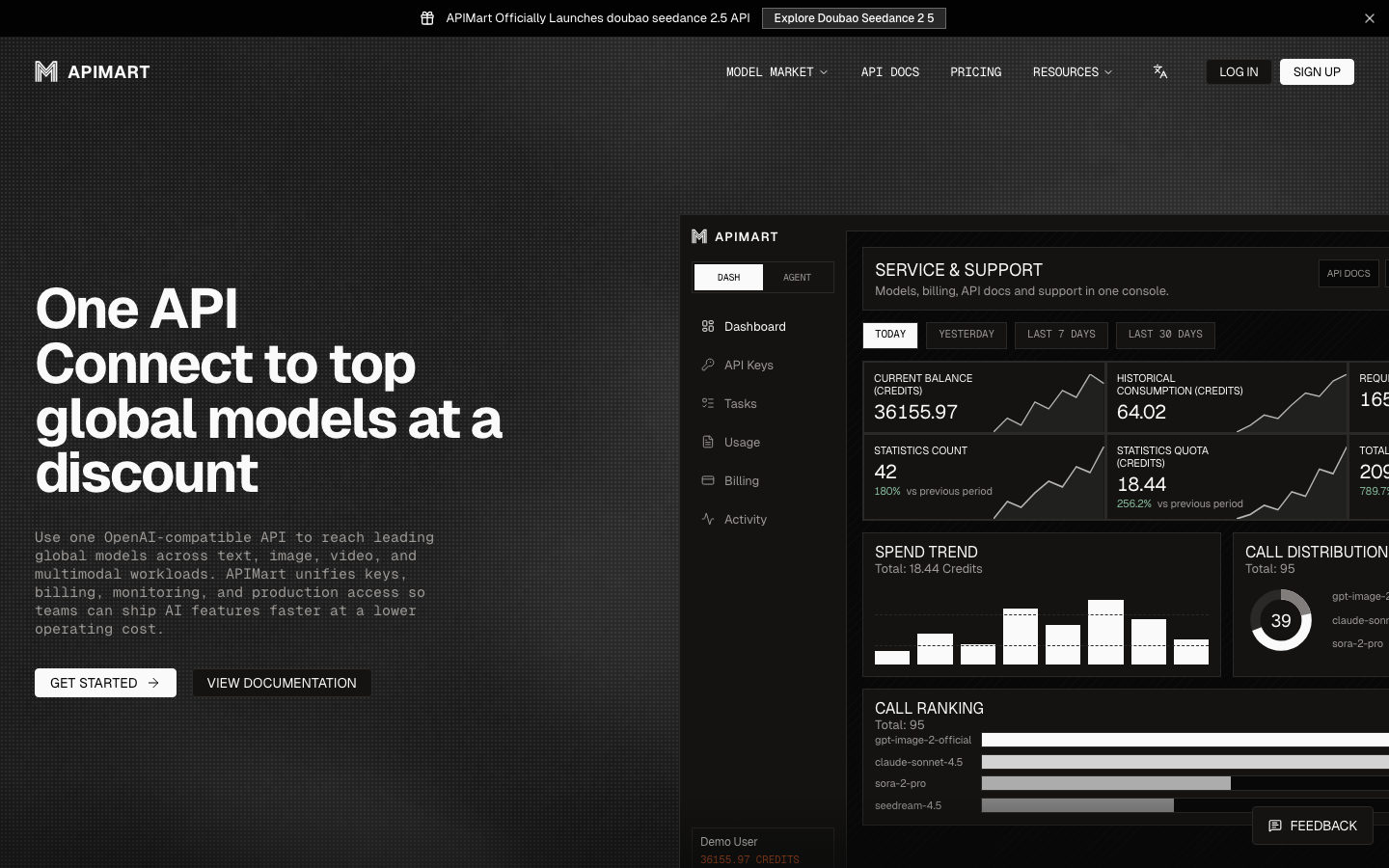
A real screenshot of the English APIMart homepage, captured on August 29, 2026. Source: APIMart.
What is APIMart?
APIMart sits between an application and a changing set of model providers. Instead of maintaining separate accounts, API keys, balances, SDK conventions, usage dashboards, and failure handling for every vendor, a team integrates one gateway and selects the model it wants for each request.
The simplest mental model is a combination of an AI model marketplace and an API gateway:
Application or agent
        |
        v
     APIMart
        |
        +-- GPT and Claude
        +-- Gemini and Qwen
        +-- Sora, Veo, Kling, Seedance, and Wan
        +-- GPT Image, Imagen, Flux, Midjourney, and Seedream
        +-- Whisper, TTS, music, and other audio models
APIMart is not a model developer. It is a third-party aggregation and infrastructure layer. Its terms identify the operator as Hangzhou Huanzhi Network Technology Co., Ltd. and state that the available third-party model catalog can change as models are added, renamed, updated, or retired.
The problem it solves
A multi-model product normally accumulates several independent integrations:
- Different authentication and account systems
- Separate prepaid balances or invoices
- Incompatible request and response formats
- Provider-specific rate limits and error behavior
- Multiple usage dashboards and cost reports
- Separate webhook and asynchronous task implementations
- A growing set of operational dependencies
APIMart consolidates much of that work behind one account. This can be especially useful for AI media products, where a single application may offer several image and video models and needs to add new releases quickly.
The gateway does not eliminate provider differences. Model-specific parameters, safety behavior, latency, output formats, and licensing still vary. It reduces the integration surface while leaving developers responsible for testing each endpoint.
OpenAI-compatible migration
For chat and other supported endpoints, APIMart documents an OpenAI-compatible base URL. An existing Python integration can often keep the OpenAI SDK and change its configuration:
python
from openai import OpenAI

client = OpenAI(
    base_url="https://api.apimart.ai/v1",
    api_key="your-apimart-key",
)
That compatibility is one of the platform's main advantages. It can reduce the initial migration work for applications already built around OpenAI-style APIs, and it makes APIMart usable by tools that accept a custom OpenAI-compatible provider.
Compatibility should not be interpreted as perfect interchangeability. APIMart's own terms explain that chat APIs follow an OpenAI-compatible request format while image and video endpoints use the formats documented for those services. Production teams should test streaming, tool calls, structured output, errors, retries, token accounting, and model-specific parameters before switching traffic.
Model and media coverage
APIMart is broader than an LLM router. Its current documentation groups endpoints into several major families:
| Category | Examples listed in APIMart documentation |
|---|---|
| Language models | GPT, Claude, Gemini, Qwen, and other chat models |
| Image generation | GPT Image, Nano Banana, Imagen, Seedream, Flux, Qwen Image, Z-Image, Midjourney, and Wan Image |
| Video generation | Sora, Veo, Seedance, Kling, Wan, MiniMax Hailuo, Vidu, PixVerse, and Grok Imagine |
| Audio | Whisper transcription, text-to-speech, music, and Suno-related endpoints |
| Platform services | Moderation, uploads, task status, callbacks, balance queries, and model metadata |
The homepage currently markets access to more than 500 models. Because model names, versions, and endpoints change quickly, developers should treat the live model list and documentation as authoritative rather than relying on a fixed catalog number.
Unified billing and monitoring
APIMart uses a shared credit balance across supported model families. That changes the operational model from funding and reconciling many vendor accounts to managing one gateway balance and usage dashboard.
The product interface highlights:
- API key management
- Current balance and historical consumption
- Request and token counts
- Spend trends
- Model call distribution
- Task tracking
- Activity and billing records
This gives APIMart a lightweight AI FinOps and observability role. It is not a replacement for application-level tracing, evaluation, or business analytics, but it provides one place to see gateway consumption across providers.
Routing, availability, and async workflows
APIMart says it uses health-aware, multi-provider routing and automatic failover. Its documentation advertises a 99.9% enterprise uptime SLA, global acceleration, rate-limit management, real-time status monitoring, and fallback routing when a provider is unavailable.
These are APIMart's service claims, not independently measured results. A production evaluation should confirm which models have multiple underlying routes, whether outputs or capabilities differ between routes, how retries are charged, and what remedies the SLA actually provides.
For image and video generation, the platform also exposes asynchronous task status and webhook callbacks. Those features are important because media generation may take far longer than an interactive chat request. Applications still need idempotency, timeout, retry, webhook verification, and cost-control logic around the gateway.
Built for coding agents as well as people
One of APIMart's more distinctive details is its public llms.txt documentation index. Developers can point Cursor, Claude Code, Codex, or another coding agent at that file and ask the agent to locate the relevant model, endpoint, parameters, and example code.
This reflects an important change in developer infrastructure: API documentation now has two audiences. Humans need readable guides, while coding agents benefit from a compact, structured index they can retrieve before editing a project.
For an agent-generated application, a typical workflow could be:
Coding agent reads APIMart llms.txt
        |
        v
Agent selects the documented endpoint
        |
        v
Agent writes an OpenAI-compatible integration
        |
        v
Developer reviews keys, permissions, costs, and output handling
The final review step remains essential. An agent can write the integration, but it cannot independently guarantee that a model's licensing, retention policy, cost profile, or regional availability is appropriate for the product.
Pricing
APIMart publishes pay-as-you-go pricing with no required plan tier. The pricing page lists rates per token, image, video duration, or other model-specific unit and frequently compares an APIMart rate with a stated official rate.
The homepage advertises savings of up to 70% in some cases, while many individual pricing rows currently show smaller discounts such as 20%. These figures are APIMart's own comparisons and vary by model, specification, and date. Buyers should verify the exact endpoint, quality tier, resolution, duration, and credit conversion immediately before estimating production costs.
APIMart can be less expensive than buying every endpoint at public retail prices if it receives channel or volume pricing. The tradeoff is the addition of another contractual and technical party between the application and the underlying provider.
APIMart compared with alternatives
APIMart overlaps with several products, but the emphasis is different:
| Platform | Main emphasis |
|---|---|
| OpenRouter | LLM model routing, provider choice, and OpenAI-compatible access |
| fal.ai | High-performance generative media APIs and serverless model deployment |
| Replicate | Managed APIs for public and custom AI models |
| Together AI | Open-model inference, fine-tuning, and AI cloud infrastructure |
| Fireworks AI | Fast open-model inference and production deployments |
| APIMart | One gateway across language, image, video, and audio models with shared billing |
APIMart is especially relevant when a product needs both frontier language models and a broad selection of commercial image or video endpoints. Teams focused only on LLM routing may prefer a more specialized router. Teams that need to deploy their own weights or control GPU infrastructure may prefer an inference platform rather than an aggregator.
Who should consider it?
APIMart is a practical candidate for:
- Independent developers building multi-model AI products
- AI SaaS teams that want to add new image or video models quickly
- Applications comparing several model providers behind one interface
- Coding-agent workflows that can consume
llms.txtdocumentation - Teams that prefer one balance and usage console over many provider accounts
- Prototypes that may change models frequently
It is less suitable for organizations that require direct contracts with every model provider, fully local inference, strict data residency without an approved gateway, or infrastructure-level control over model serving.
Production and privacy considerations
Using an API aggregator introduces a second layer of trust: both APIMart and the selected underlying provider participate in the request path. Before using it for proprietary code, personal data, or regulated workloads, verify:
- Whether prompts, uploaded files, and outputs pass through or are retained by APIMart
- Which endpoints use official direct channels and which use alternative routes
- Logging defaults and deletion periods
- Provider-specific zero-data-retention behavior
- Data processing agreements and regional processing options
- API key encryption, rotation, and revocation
- Webhook signing and asynchronous task retention
- SLA measurement, exclusions, support response, and credits
- Model retirement and backward-compatibility policy
APIMart says it does not use request inputs or outputs to train models and offers enterprise data-processing terms. Those statements should be confirmed against the applicable contract and the policies of each underlying provider.
Verdict
APIMart is more accurately described as an AI API infrastructure gateway than a simple API reseller. The value is the combination of access, OpenAI-compatible integration, shared billing, routing, monitoring, and a wide media-model catalog.
Its strongest use case is a product that would otherwise maintain many separate language, image, video, and audio integrations. The main tradeoff is dependency on an additional intermediary, so the benefits in speed and model choice should be weighed against data governance, provider transparency, reliability, and long-term compatibility.
The llms.txt integration also makes APIMart relevant to the next generation of developer tools. As coding agents increasingly discover and integrate APIs on a developer's behalf, gateways that expose machine-readable documentation, model registries, billing, and routing may become infrastructure not only for applications, but for the agents that build them.
Official resources: APIMart website, documentation, pricing, and terms.
Model support & data privacy
Supported models
- GPT
- Claude
- Gemini
- Qwen
- Sora
- Veo
- Kling
- Seedance
- Wan
- MiniMax Hailuo
- GPT Image
- Imagen
- Flux
- Midjourney
- Seedream
- Whisper
- TTS
Privacy & data handling
Requests pass through APIMart to third-party model providers. APIMart states that it does not use inputs or outputs for model training and offers enterprise data-processing terms, but teams should verify request routing, logging and deletion, provider retention, data residency, webhook storage, credential controls, and the applicable contract before sending proprietary or regulated data.
Guides, reviews & fixes
No published guides yet. Start with the official documentation above.
Product updates
No verified product updates listed yet. Follow this tool to see new relevant content in Saved.
See the content timelineAlternatives
OpenRouterA unified model-routing API for multi-model coding agents and AI applications. Fal AIfal.ai is a developer-first generative media infrastructure platform for calling hosted AI model APIs or deploying custom models on serverless GPU infrastructure.
 ReplicateReplicate is an API-first AI model platform for developers who want managed inference and model deployment without operating GPU infrastructure.
 Together AITogether AI is a developer infrastructure platform for teams that want hosted open-model inference, fine-tuning, evaluations, and GPU-backed deployment rather than a full AI code editor.
 Fireworks AIFireworks AI is a developer infrastructure platform for fast open-model inference, fine-tuning, and dedicated AI model deployment.
Sources & verification
Verification dates record when this directory checked the information. Product release dates appear separately above.
Directory revision history
Created an English directory profile from current official website, documentation, pricing, llms.txt, and terms; added official logo and a real homepage screenshot.