
 MomenticA repository-friendly agentic QA platform that turns natural-language intent into self-healing web and mobile tests and closes coverage gaps around pull requests and commits.
AI QA Agent (KaneAI)
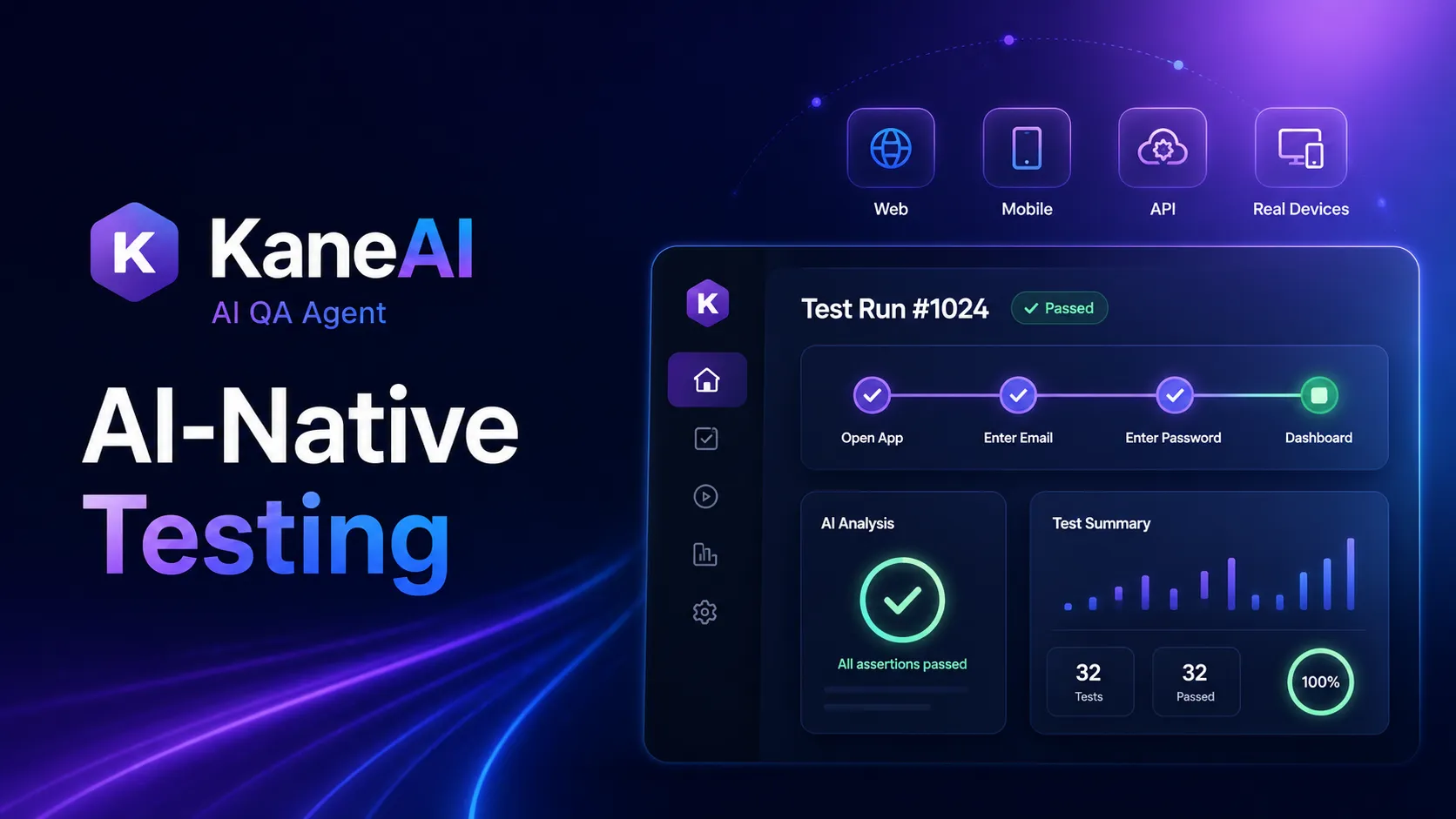
KaneAI is an AI-native software QA agent positioned between traditional scripted test automation and autonomous agentic testing platforms.
Information checked: Aug 14, 2026 ·View sources
Tool details
- Type
- Review & testing
- Platforms
- Browser, CLI
- Free plan
- No
- Open source
- No
- Bring your own key
- No
- Local models
- No
Overview
Best for
- QA teams converting product requirements into executable regression coverage
- Manual testers moving toward automation without writing every test from scratch
- Engineering teams adding automated QA gates to fast release cycles
- Vibe-coding teams that need independent validation of AI-generated application changes
- Organizations testing web and mobile journeys across many browser and device combinations
- Teams that want AI-assisted testing while retaining the option to export conventional automation code
Strengths
- Reduces the amount of manual scripting needed to create end-to-end tests.
- Combines AI authoring with real execution rather than stopping at test-case suggestions.
- Useful for both manual QA teams and automation engineers.
- Framework export provides a path back to conventional test code.
- Fits CI/CD, Jira, and engineering workflows instead of operating only as a standalone QA interface.
- Supports broader web and mobile testing workflows than code-review-only QA agents.
Limitations & trade-offs
- Teams looking only for static code review or pull-request comments
- Projects requiring a completely self-hosted or offline AI testing stack
- Developers whose primary requirement is unit-test generation rather than application-level QA
- Teams that require an open-source QA agent they can modify internally
- Organizations unwilling to review AI-generated assertions before making them release gates
- AI-generated test intent and assertions still require human review for business-critical workflows.
- Cloud web and mobile authoring capabilities are concentrated in the higher pricing tiers.
- Credit-based usage can make costs depend on how heavily teams use agentic authoring and cloud execution.
- It is a hosted commercial platform rather than an open-source testing agent.
- Teams needing fully offline or self-hosted AI inference should look elsewhere.
Get started
Pricing & usage limits
Official pricingFrom $19
Starter$19 / agent/month
2,000 monthly credits with local Kane CLI authoring; annual billing is approximately $17 per agent/month.
Pro$99 / agent/month
12,000 credits, Cloud KaneAI Web authoring, and 100 HyperExecute minutes per month.
Max$199 / agent/month
25,000 credits, Cloud KaneAI Web and Mobile authoring, and 300 HyperExecute minutes per month.
EnterpriseCustom
Higher-volume deployment with unlimited credits, SSO, enterprise controls, and custom commercial terms.
Pricing checked: Aug 14, 2026 · Subscription, usage limits, and model costs may be billed separately.
Features & details
AI Test Authoring
- Create executable tests from natural-language instructions
- Generate coverage from PRDs, Jira tickets, documents, and other requirements
- Build conditional and reusable test flows
- Generate structured assertions without hand-writing every test step
Execution & Maintenance
- Run tests across web, mobile, API, and real-device environments
- Self-heal element targeting when application interfaces change
- Analyze failures with AI-assisted root-cause workflows
- Capture execution evidence including logs, screenshots, and recordings
Developer Workflow
- Integrate testing into CI/CD and pull-request workflows
- Sync testing workflows with Jira and Azure DevOps
- Export automation to Selenium, Playwright, Cypress, and Appium
- Use Kane CLI for terminal-native local authoring
Why Choose an AI QA Agent Like KaneAI?
KaneAI is most interesting when test automation itself has become a development bottleneck. Conventional frameworks such as Playwright, Cypress, Selenium, and Appium are highly capable, but every important journey still has to be translated into test logic, assertions, fixtures, selectors, and maintenance work.
An AI QA agent changes the abstraction. Instead of beginning with implementation details, the team begins with intent: what a user should be able to accomplish, what outcome should be considered correct, and which failure conditions matter.
That distinction is especially relevant for teams adopting AI coding agents and vibe-coding workflows. Application code can now change much faster than a manually maintained regression suite. An independent QA agent can act as a validation layer between generated code and deployment rather than asking the same coding agent to judge its own work.
The important caveat is that faster test creation does not eliminate test strategy. Someone still has to decide which behavior is important, which edge cases represent real business risk, and whether an apparently successful interaction actually proves the intended outcome.
Core Workflow
A practical KaneAI workflow starts from a requirement rather than from an automation framework.
A product requirement, ticket, acceptance criterion, or release objective is first converted into testable user journeys. The generated scenarios should then be reviewed before becoming part of the long-term regression suite. This human review step matters because an AI agent can automate an incorrect interpretation of a requirement just as efficiently as a correct one.
Execution should normally happen against predictable development or staging environments with dedicated accounts and controlled test data. Failed runs can then feed back into engineering as reproducible defects rather than vague QA reports.
For stable scenarios, exporting or integrating the resulting automation into the team's normal CI pipeline creates a useful separation between test creation and routine regression execution. Agentic reasoning can then be reserved for situations where it adds value instead of being invoked for every deterministic step.
AI QA for Vibe Coding
AI-generated applications create a new QA problem: the cost of producing code has fallen faster than the cost of verifying it.
A developer using Cursor, Claude Code, Codex, Replit Agent, or another coding agent can make several significant interface changes in a single session. Manually checking login, onboarding, billing, forms, permissions, responsive states, and other critical journeys after every change quickly becomes unrealistic.
KaneAI fits this workflow as a second layer rather than as another code generator. The coding agent implements the feature; the QA agent exercises the running product from the user's perspective. This separation is valuable because a test that interacts with the deployed application can expose integration and behavioral failures that static inspection of the generated source may not reveal.
For vibe-coded projects, the highest-value starting point is usually a compact set of business-critical journeys rather than hundreds of automatically generated cases. Authentication, signup, checkout, subscription changes, destructive actions, and primary conversion flows make better initial quality gates than exhaustive low-risk coverage.
Use Cases
KaneAI can make sense for teams moving from manual release checklists to repeatable automated regression testing. The QA engineer can describe the workflow in domain language while gradually introducing more conventional automation where deterministic control becomes important.
It is also useful for requirement-driven development. A ticket or product specification can become the starting point for QA coverage before implementation is considered complete, helping move testing closer to the development cycle rather than leaving it as a final release-stage activity.
Another strong use case is release-candidate validation across multiple environments. Instead of relying on one developer's local browser, teams can define important journeys once and evaluate them consistently as the application changes.
The product is less compelling when the testing problem is primarily unit-level correctness. A project that mainly needs generated Jest, pytest, JUnit, or similar unit tests may get more value from a coding agent or dedicated unit-test generation tool than from a user-journey-oriented QA platform.
Comparison to Alternatives
Momentic targets a similar developer-facing workflow built around natural-language end-to-end testing and agentic interactions. It deserves direct comparison when the priority is integrating AI-based E2E testing closely with an engineering workflow.
Autify Aximo is another close substitute. Its autonomous testing approach is particularly relevant when teams want an AI tester operating across user-facing application experiences without manually specifying every interaction.
mabl competes from the perspective of a broader established testing platform. Teams already thinking in terms of organization-wide test management and continuous quality engineering should compare its agentic capabilities with KaneAI rather than evaluating only the quality of natural-language generation.
Spur is particularly comparable for teams interested in AI agents that behave more like users than traditional selector-driven automation. The practical evaluation should therefore focus on how reliably each system handles the team's real application, authentication patterns, dynamic interfaces, test data, and failure diagnosis rather than on generic AI feature counts.
Best Configuration
Start with roughly ten to twenty journeys that would materially hurt the business if they broke. A smaller trusted suite produces more value than hundreds of automatically generated scenarios nobody reviews.
Use dedicated test accounts and deterministic seed data wherever possible. AI can adapt to interface variation, but it cannot compensate for an environment whose state changes unpredictably between runs.
Assertions deserve more attention than actions. Clicking through checkout is easy; deciding what proves that checkout actually succeeded is the important part. Explicitly define expected state changes, persisted records, confirmation states, permissions, or other meaningful outcomes.
Keep agentic behavior for the portions of a journey that genuinely require interpretation. Stable operations can remain deterministic. This hybrid approach generally makes failures easier to reproduce and also limits unnecessary AI usage.
Finally, treat generated automation as engineering assets. Review important tests, version them, connect them to release gates, and periodically remove obsolete coverage rather than allowing an automatically generated suite to grow indefinitely.
Migration Notes
Teams already using Playwright, Cypress, Selenium, or Appium should not assume that adopting an AI QA agent requires replacing the existing suite.
A lower-risk migration strategy is to preserve reliable tests and use KaneAI for new coverage, difficult-to-maintain workflows, exploratory scenarios, or requirements that currently receive only manual testing. Measure maintenance time, failure quality, execution stability, and escaped defects before migrating additional coverage.
Duplicate scenarios should eventually have a clear owner. Running an old scripted flow and a new AI-authored version indefinitely wastes execution capacity and makes failures harder to interpret.
For organizations with a large manual QA function, adoption can be gradual as well. Testers can first use the agent to formalize repeatable release checks, while automation engineers review the resulting cases and decide which workflows should become permanent CI gates.
The broader goal is not to replace every conventional test with an autonomous agent. It is to reduce the distance between a product requirement and a trustworthy automated check while keeping enough human and deterministic control to make failures actionable.
Model support & data privacy
Privacy & data handling
KaneAI is part of TestMu AI's hosted testing platform, so teams should treat prompts, test data, credentials, screenshots, recordings, and other execution artifacts as potentially sensitive testing data. TestMu AI documents enterprise security controls including SSO, RBAC, audit logging, compliance controls, and data-retention options; organizations handling regulated or production data should review the current security and privacy documentation before deployment.
Guides, reviews & fixes
No published guides yet. Start with the official documentation above.
Product updates
No verified product updates listed yet. Follow this tool to see new relevant content in Saved.
See the content timelineAlternatives
MomenticA repository-friendly agentic QA platform that turns natural-language intent into self-healing web and mobile tests and closes coverage gaps around pull requests and commits. AximoAn autonomous cross-application AI tester that validates behavior like a user and can also provide context to coding agents for generating owned test scripts.
 SpurA browser-based AI QA engineer aimed at giving product and engineering teams fast, maintainable end-to-end coverage without hand-writing every test script.
Sources & verification
Verification dates record when this directory checked the information. Product release dates appear separately above.
Official websiteKaneAI official product pageKaneAI documentationTestMu AI pricingKaneAI RBAC documentation
Directory revision history
Pricing and product positioning checked against the current TestMu AI product, documentation, and pricing pages.
Official KaneAI web-testing documentation was updated for the current web test generation and execution workflow.
LambdaTest rebranded as TestMu AI while KaneAI continued as the platform's GenAI-native testing agent.