
On This Page8 sections
Key Takeaways
- OpenAI reset usage limits for paid ChatGPT Work and Codex users again on August 11, 2026.
- The August 11 event appears to be a global or hard reset, not unlimited usage and not necessarily a banked reset credit.
- It is only the latest in a long series of Codex resets during June, July, and August 2026.
- Previous resets have been associated with reliability incidents, outages, unusually high usage consumption, user-growth milestones, model launches, and promotional events.
- A particularly notable June 18 event delivered a double reset: one immediate reset plus one banked reset.
- OpenAI also used resets around the 9 million and 10 million Codex user milestones in July.
- ChatGPT Work and Codex share usage, so heavy activity in either product can affect the same broader allowance.
- The reset does not mean users received additional OpenAI API credits or that subscription usage is permanently unlimited.
- Heavy users benefit the most because a hard reset is significantly more valuable when most of the previous allowance has already been consumed.
What Happened on August 11, 2026?
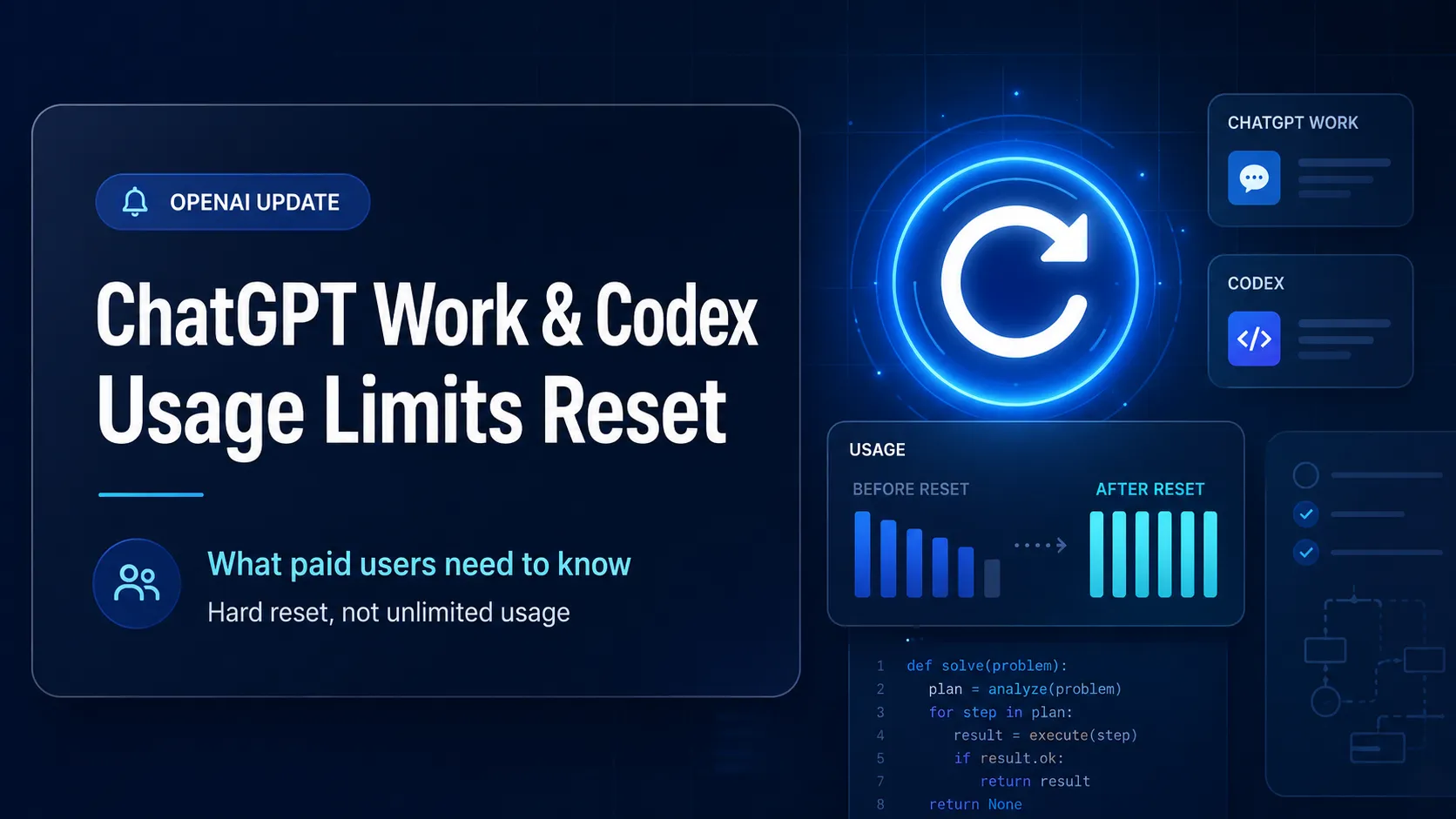
OpenAI reset usage limits for paid ChatGPT Work and Codex users on August 11, 2026.
The announcement was concise:
Usage limits have been reset for all paid ChatGPT Work and Codex users.
For developers who were approaching their usage ceiling, this can represent a meaningful amount of additional agent capacity.
However, the announcement should not be interpreted as a permanent increase in subscription limits. It refreshes applicable usage windows rather than removing the underlying quota system.
The August 11 reset is particularly notable because it happened only a few days after another reset on August 8.
The Full ChatGPT Work and Codex Reset Timeline
The August 11 event makes much more sense when viewed as part of OpenAI's broader reset pattern.
Some resets compensated users for technical problems. Others celebrated adoption milestones or accompanied changes to models and usage limits.
| Date | Reset Background |
|---|---|
| June 4, 2026 | Codex experienced three reliability incidents within roughly 24 hours, and OpenAI reset usage for paid plans as compensation. |
| June 18, 2026 | OpenAI delivered what was described as a “sneaky double reset”: one immediate usage reset plus one banked reset that could be retained for later use. |
| June 26–29, 2026 | Additional capacity was distributed while OpenAI investigated reports of unexpected or unusually fast usage consumption. |
| July 13, 2026 | Another reset was issued around a Codex user-growth milestone, giving active users additional capacity. |
| July 14, 2026 | Continued rapid adoption was followed by another global reset. |
| July 16, 2026 | OpenAI marked the 9 million Codex user milestone with another usage reset. |
| July 21, 2026 | Codex reached approximately 10 million users, followed by another reset. |
| July 25, 2026 | A reset was issued after a major outage affecting users across many regions, functioning as service compensation. |
| July 28, 2026 | OpenAI celebrated rapid ChatGPT Work adoption and reset usage again. |
| July 29, 2026 | Another reset accompanied changes related to GPT-5.6 Sol usage limits. |
| August 1, 2026 | OpenAI launched a “week of efficiency” initiative and reset usage again. |
| August 8, 2026 | Another reset was issued around GPT-5.6 Sol, giving paid users refreshed capacity. |
| August 11, 2026 | OpenAI performed another reset, effectively fulfilling the previously teased “Monday reset” commitment. |
This timeline shows that the resets are not driven by a single cause.
They fall into several distinct categories:
- Reliability compensation: June 4 and July 25.
- Usage-accounting investigations: June 26–29.
- User-growth milestones: July 13, July 14, July 16, and July 21.
- Product and adoption events: July 28.
- Model and limit changes: July 29 and August 8.
- Promotional or community events: August 1 and August 11.
This is an important distinction. A new reset does not automatically imply that Codex suffered another outage.
Why the August 11 Reset Happened So Soon After August 8
The timing is unusual.
OpenAI had already reset usage on August 8. Community members quickly pointed out that some accounts had only recently received their normal weekly renewal, reducing the practical value of another immediate reset.
The response from Tibo was effectively a promise to do another reset on Monday.
The August 11 announcement appears to be the fulfillment of that commitment.
That makes this particular event different from resets explicitly tied to reliability incidents.
Instead, it looks more like a combination of:
- Community engagement
- Temporary capacity expansion
- Product promotion
- Encouraging heavier ChatGPT Work and Codex usage
What Does a Codex Usage Reset Actually Mean?
Codex does not operate with a simple monthly message counter.
Agent workloads can be governed by several overlapping constraints, including rolling usage windows and longer-term allowances.
A reset effectively refreshes an applicable usage window.
For example:
Before reset
Weekly usage remaining: 6%
Usage consumed: 94%

After applicable reset
Usage window: refreshed
For a heavy user, the difference can be substantial.
Compare that with another account:
Before reset
Weekly usage remaining: 95%
Usage consumed: 5%
That user receives much less incremental value because most of the previous allowance had not yet been consumed.
This is why global resets disproportionately benefit power users.
Hard Reset vs. Banked Reset
One of the most important details is the difference between an immediate reset and a banked reset.
Hard or Global Reset
A hard reset immediately refreshes an applicable usage window.
Typical characteristics include:
- The reset happens automatically.
- Users generally cannot save it for later.
- Remaining allowance should not be assumed to stack with the new allowance.
- Users already near their usage ceiling receive the greatest benefit.
A hard reset is best understood as resetting the meter.
Banked Reset
A banked reset works differently.
Instead of immediately replacing the current usage window, the additional reset can be stored and used later.
That makes it more valuable for users whose existing allowance is still mostly unused.
The June 18 event is particularly interesting because it combined both mechanisms:
Reset 1: Immediate reset
Reset 2: Banked reset for later use
This type of event is materially more valuable than an ordinary hard reset because the second benefit does not need to be consumed immediately.
Which Type Is the August 11 Reset?
The August 11 announcement says that usage limits have been reset.
It does not explicitly state that users received an additional banked reset.
The most reasonable interpretation is therefore that this was a global or hard reset rather than another June 18-style double reset.
Users should not assume that a saved reset credit exists unless it appears explicitly in their account interface.
Does the Reset Mean Codex Is Unlimited?
No.
A reset does not mean:
- Unlimited Codex usage
- Unlimited ChatGPT Work tasks
- Removal of weekly limits
- Permanent doubling of subscription capacity
- Unlimited premium-model use
- Unlimited cloud-agent execution
Normal consumption starts again after the reset.
A developer running several large repository-wide tasks could therefore consume a meaningful portion of the refreshed allowance relatively quickly.
Why Codex Usage Is Different From Traditional Chat Messages
Agentic coding workloads vary dramatically in computational cost.
A single request can involve only a minor code edit, while another can trigger extensive repository exploration, reasoning, terminal commands, testing, tool usage, and iterative fixes.
Consumption can be influenced by factors such as:
- Repository size
- Context length
- Number of files inspected
- Model selection
- Reasoning complexity
- Tool calls
- Terminal operations
- Test execution
- Retrieval
- Cache reuse
- Cloud execution
- Overall task duration
Consider these two requests:
Rename this variable in one function.and:
Analyze the entire repository, upgrade the framework, migrate deprecated APIs,
run the complete test suite, fix regressions, update documentation,
and prepare the final production-ready patch.
Both technically start with one user instruction, but their compute requirements are radically different.
This is why Codex usage is better understood as available agent compute rather than a simple message count.
Why ChatGPT Work Is Included
The announcement specifically refers to both ChatGPT Work and Codex.
That matters because ChatGPT Work extends agent execution beyond traditional coding tasks.
Work can support longer-running workflows involving:
- Research
- Documents
- Presentations
- Spreadsheets
- File analysis
- Data processing
- Web applications
- Multi-step business workflows
ChatGPT Work and Codex can share the same broader usage allocation.
For example:
Morning
Run several Codex agents across development repositories.

Afternoon
Launch a long ChatGPT Work research and document task.

Result
Both activities may contribute to the same broader usage allowance.
That shared structure explains why recent announcements increasingly mention both products together.
Who Gets the August 11 Reset?
The wording specifically refers to paid ChatGPT Work and Codex users.
Users should therefore not automatically assume that free-tier accounts receive the same reset.
The practical impact can also differ across organizational plans because enterprise and education environments may use flexible credit arrangements or customized limits.
The account's actual usage dashboard remains the best indicator of available capacity.
Does the Reset Include OpenAI API Credits?
No evidence suggests that it does.
ChatGPT subscription usage and OpenAI API billing are separate systems.
The reset should not be interpreted as providing:
- Free API balance
- Additional prepaid API credits
- Lower API token pricing
- Higher API rate limits
- A reset of API spending limits
A developer can use Codex through a ChatGPT subscription and separately use OpenAI models through an API key. Those two paths have different usage and billing mechanics.
What the Reset History Reveals About OpenAI's Strategy
The frequency of resets is more interesting than any individual event.
OpenAI has repeatedly given paid users additional agent capacity during a period when Codex and ChatGPT Work are expanding rapidly.
Three strategic effects stand out.
1. Resets Encourage Larger Agent Workloads
Agent products become more valuable when users delegate jobs that take minutes or hours rather than individual chat turns.
Extra capacity encourages developers to experiment with:
- Repository-wide refactoring
- Dependency upgrades
- Framework migrations
- Automated testing
- Parallel coding agents
- Large research jobs
- Long document workflows
- Multi-step autonomous tasks
Users become less likely to conserve every unit of usage and more willing to discover what agents can accomplish autonomously.
2. Available Compute Is Becoming a Product Feature
AI coding products are often compared primarily on model quality.
That is increasingly incomplete.
Consider two agents:
Agent A
Excellent benchmark performance
Very restrictive usage limits

Agent B
Slightly lower benchmark performance
Much larger usable allowance
For a professional developer running agents continuously, Agent B may produce more useful work over an entire week.
The effective value of a coding agent increasingly depends on:
Model capability × reliability × available compute × workflow integration
3. Temporary Resets Provide Real-World Demand Data
Relaxing limits also lets OpenAI observe how users behave when they are less concerned about conserving capacity.
That can expose real demand for:
- Longer tasks
- Greater parallelism
- Larger repositories
- Higher reasoning budgets
- More autonomous execution
- More cloud-agent runtime
Those usage patterns can influence future product limits and pricing structures.
Why Heavy Users Benefit the Most
The value of a hard reset depends heavily on previous consumption.
Consider two accounts:
User A
Remaining allowance: 5%
After reset: refreshed window
Incremental benefit: very high

User B
Remaining allowance: 90%
After reset: refreshed window
Incremental benefit: relatively low
This means resets provide disproportionate value to developers already running large quantities of agent work.
Good candidates for refreshed capacity include:
- Large framework migrations
- Repository-wide type fixes
- Dependency modernization
- Test generation
- Documentation generation
- Security reviews
- Large refactoring projects
- Parallel implementation agents
How to Use Refreshed Capacity Efficiently
A reset does not mean usage should be consumed simply because it is available.
The better strategy is to prioritize work with high expected productivity per unit of human attention.
Good Tasks After a Reset
- Complex repository analysis
- Multi-file refactoring
- Framework upgrades
- Large bug investigations
- Automated test generation
- Repetitive migration work
- Parallel agent tasks
- Long-running ChatGPT Work projects
Lower-Priority Tasks
Simple syntax questions, tiny edits, and basic documentation lookups rarely require premium agent capacity.
Those can often be handled by lighter models or conventional development tools.
Common Misunderstandings
"My dashboard does not immediately show 100%. Did the reset fail?"
Not necessarily.
Different usage windows may refresh independently, interfaces can update at different times, and new activity can begin consuming capacity almost immediately.
"Does my unused allowance stack with the reset?"
Users should not assume so.
A standard hard reset normally refreshes the meter rather than adding the remaining balance to an entirely new allocation.
"Can the August 11 reset be saved for later?"
There is no indication that this is a banked reset.
The June 18 event explicitly demonstrated that OpenAI can issue banked resets when it intends to provide one.
"Did OpenAI permanently increase Codex limits?"
No.
A reset changes current usage state. It does not automatically change the long-term entitlement of a subscription.
"Did API users receive free tokens?"
No evidence indicates that the subscription reset provides API credits.
What This Means for the AI Coding Market
The repeated reset events highlight a larger shift in competition between AI development tools.
The old question was:
Which model writes the best code from a prompt?
The more important question is increasingly:
How much useful autonomous work can the system complete before it hits a usage, reliability, or workflow constraint?
Modern coding agents now compete across multiple dimensions:
- Reasoning quality
- Coding accuracy
- Repository understanding
- Context capacity
- Agent reliability
- Terminal execution
- Tool integration
- Parallelism
- Latency
- Available usage
- Pricing
- Cloud execution
That makes usage economics an increasingly important factor when comparing Codex with Claude Code, Cursor, Windsurf, Gemini-based coding agents, and other development platforms.
What to Watch Next
Another temporary reset would be useful, but several potential changes would have much larger long-term consequences.
Permanent Usage Increases
A formal increase to recurring Codex and ChatGPT Work limits would matter more than occasional promotional resets.
More Banked Resets
The June 18 double-reset model is particularly attractive because users can preserve additional capacity instead of immediately replacing an almost-full usage window.
Agent-Focused Subscription Tiers
Heavy agent users may eventually need plans designed around compute capacity rather than conventional chatbot messaging patterns.
Flexible Compute Credits
Bankable or transferable compute credits would allow teams to concentrate capacity around actual project deadlines.
Model-Specific Economics
Lighter models may offer dramatically more tasks per subscription while premium reasoning models remain more expensive in terms of usage consumption.
Competition on Available Agent Compute
As AI coding tools converge in capability, the amount of useful compute available under each subscription could become one of the most important differentiators.
Conclusion
OpenAI's August 11, 2026 reset gives paid ChatGPT Work and Codex users another refreshed usage window, but the event is more significant when viewed alongside the series of resets that began in June.
During that period, OpenAI has used resets for outage compensation, reliability problems, usage investigations, major user-growth milestones, ChatGPT Work adoption, model updates, and community events.
The August 11 event appears to be a hard or global reset rather than a banked reset, meaning users who had already consumed most of their allowance receive the greatest immediate value.
For active developers, the practical action is straightforward: check the current usage dashboard and prioritize high-value, compute-intensive agent tasks while refreshed capacity is available.
The bigger development to watch is whether these frequent temporary resets eventually evolve into permanently higher usage limits, more banked credits, flexible compute pricing, or dedicated agent-focused subscription tiers.
Continue Reading
More articles connected to the same themes, protocols, and tools.

ChatGPT Pro 200 Is Losing Half Its Usage: Pro 500, GPT-6.1 Sol, Dots and the October 30 Changes Explained
OpenAI DevDay 2026: 25 Biggest Announcements and What They Mean
OpenAI Plugin Extensions Could Be ChatGPT’s App Store Moment: Real Examples, User Reactions, and the New Plugin SEO
Referenced Tools
Browse entries that are adjacent to the topics covered in this article.