
On This Page8 sections
Key Takeaways
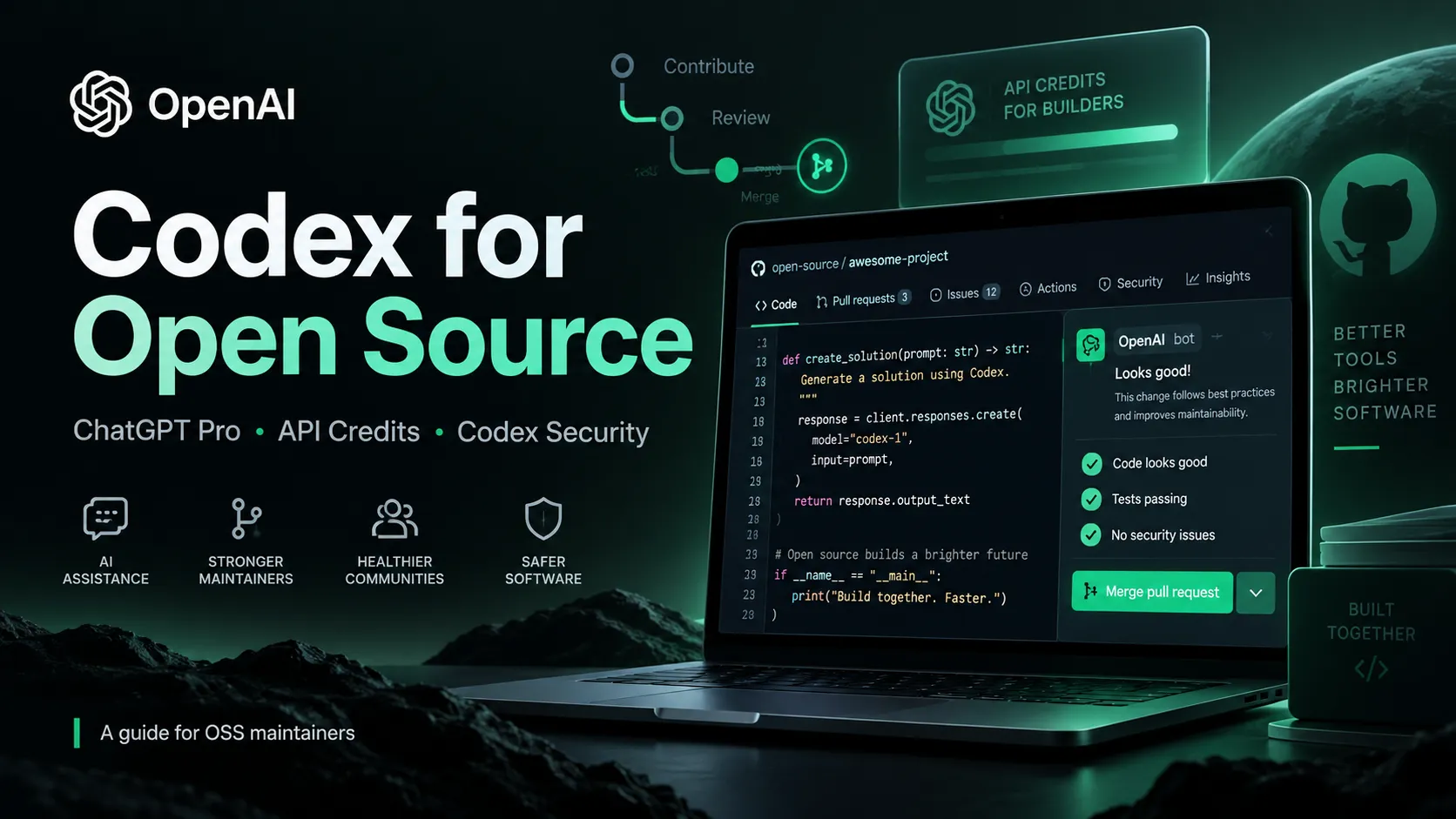
- OpenAI's Codex for Open Source program is built for active maintainers of important public open-source projects, especially primary and core maintainers handling pull request review, issue triage, releases, security, and code quality.
- Selected maintainers can receive six months of ChatGPT Pro with Codex, API credits for open-source maintenance workflows, and conditional access to Codex Security.
- Applications are reviewed on a rolling basis. OpenAI says it considers repository usage, broad adoption, ecosystem importance, and evidence of active maintenance.
- This is not simply a free ChatGPT Pro promotion. A strong application connects measurable project impact with real maintainer workloads that Codex can help reduce.
- OpenAI also operates a separate $1 million Codex Open Source Fund, with grants of up to $25,000 in API credits. That amount should not be presented as a guaranteed benefit of every Codex for Open Source approval.
- For security-sensitive repositories, Codex Security may be particularly valuable because it can build a repository-specific threat model, validate potential vulnerabilities, and propose patches for human review.
What Is OpenAI Codex for Open Source?
Codex for Open Source is an OpenAI program designed to support the maintainers behind important open-source software.
Successful open-source projects generate a large amount of work that is often invisible to end users. Maintainers do much more than write code. They review pull requests, reproduce bugs, triage issues, coordinate releases, investigate regressions, maintain compatibility, respond to security reports, review dependency changes, and help outside contributors understand the codebase.
OpenAI positions Codex for Open Source as a way to reduce some of that coding and review burden with tools designed for real maintenance workflows.
As of September 2026, the official program lists three major benefits:
- Six months of ChatGPT Pro, including Codex.
- API credits for coding, maintainer automation, release workflows, and other core open-source work.
- Conditional access to Codex Security for qualifying repositories that need deeper security coverage.
The important point is that this can be more than a free coding assistant subscription. For projects with busy issue trackers, frequent releases, or large contributor communities, Codex can become part of the project's maintenance infrastructure.
Who Can Apply?
OpenAI says maintainers of active open-source projects can apply. The program looks for projects with meaningful usage, broad adoption, or clear importance to the software ecosystem.
The application form asks applicants to identify themselves as a primary maintainer or core maintainer and provide a public GitHub repository.
A strong applicant therefore has more than repository ownership. Useful evidence includes ongoing responsibility for tasks such as:
- Reviewing and merging pull requests.
- Triaging bug reports and feature requests.
- Publishing releases.
- Maintaining CI/CD workflows.
- Investigating regressions.
- Managing compatibility across supported platforms or runtimes.
- Responding to security reports.
- Reviewing dependency upgrades.
- Maintaining examples and documentation.
- Supporting downstream projects.
OpenAI also says developers can apply for their own project or nominate another maintainer. If a project does not perfectly match the listed criteria but plays an important role in the ecosystem, OpenAI explicitly encourages applicants to explain why it matters.
What Do Selected Maintainers Receive?
Six Months of ChatGPT Pro With Codex
Selected maintainers can receive six months of ChatGPT Pro, including access to Codex.
For maintainers, Codex can assist with work such as:
- Understanding unfamiliar contributor patches.
- Refactoring legacy subsystems.
- Generating or repairing tests.
- Investigating regressions.
- Explaining build failures.
- Reviewing large diffs.
- Reproducing issues.
- Updating documentation alongside code changes.
- Producing migration guidance.
- Exploring unfamiliar parts of a repository before making changes.
The real advantage comes from repetition. An active maintainer may perform the same categories of work hundreds or thousands of times per year. Saving even a few minutes per issue or pull request can add meaningful maintenance capacity.
API Credits for Maintainer Automation
Selected maintainers may also receive OpenAI API credits for projects using Codex in pull request review, maintainer automation, release workflows, or other core OSS work.
This can be more strategically useful than the Pro subscription for projects with mature automation.
Instead of manually prompting Codex for every task, maintainers can build repeatable workflows around repository events.
For example:
New pull request
      ↓
Classify affected subsystems
      ↓
Inspect changed behavior
      ↓
Check likely regression areas
      ↓
Identify missing tests
      ↓
Generate a review summary
      ↓
Human maintainer reviews the result
Issue triage can follow a similar pattern:
New GitHub issue
      ↓
Classify bug / feature / support / duplicate
      ↓
Extract environment details
      ↓
Check reproduction steps
      ↓
Locate likely related code
      ↓
Request missing information
      ↓
Apply suggested labels for maintainer review
A strong application describes these concrete workflows rather than saying only that credits will be used to "increase developer productivity."
Conditional Access to Codex Security
Qualifying repositories may also be considered for Codex Security. OpenAI describes Codex Security as an application-security agent that builds context about a project, produces a threat model, identifies potential vulnerabilities, validates findings, and proposes fixes.
Its workflow differs from a traditional static scanner.
Codex Security can:
- Analyze the repository's security-relevant architecture.
- Build a codebase-specific threat model.
- Explore realistic attack paths.
- Validate suspected vulnerabilities in an isolated environment.
- Prioritize findings based on likely real-world impact.
- Generate remediation guidance.
- Propose targeted patches for human review.
OpenAI says proposed fixes are presented for review rather than automatically modifying repository code.
This is particularly relevant to open-source maintainers because security reports can create their own triage burden. A maintainer must determine whether a report is reproducible, exploitable, duplicated, already fixed, incorrectly rated, or simply a theoretical finding with limited practical impact.
OpenAI has reported using Codex Security in open-source security work involving projects including OpenSSH, GnuTLS, GOGS, libssh, PHP, Chromium, and others.
Codex for Open Source vs. the $1 Million Codex Open Source Fund
Two related OpenAI initiatives can easily be confused.
Codex for Open Source is the maintainer program that offers six months of ChatGPT Pro, potential API credits, and conditional access to Codex Security.
OpenAI also operates a Codex Open Source Fund, described as a $1 million initiative supporting open-source projects that use Codex CLI and OpenAI models. The fund states that projects can receive grants of up to $25,000 in API credits.
The distinction matters:
- Do not assume every Codex for Open Source approval includes $25,000.
- Do not describe $25,000 as the standard benefit of the maintainer program.
- The Open Source Fund has its own funding language and application process.
- The Codex for Open Source page promises potential API-credit support but does not state that every selected maintainer receives the maximum fund amount.
For projects expecting substantial API usage, the application should therefore explain exactly what will consume those credits and how that usage benefits the open-source project.
What Does the Application Ask For?
The current Codex for Open Source application is relatively short, but several fields require preparation.
Applicants are asked for:
- Name.
- The email connected to the applicant's ChatGPT account.
- GitHub username.
- Public GitHub repository URL.
- Whether the applicant is a primary or core maintainer.
- Why the repository qualifies.
- Whether the applicant wants Codex Security.
- Whether the applicant wants API credits.
- OpenAI organization ID.
- How the API credits would be used.
- Optional additional information.
Several important narrative fields currently have a 500-character limit, including the repository qualification explanation and API-credit use case.
That means every sentence needs to carry evidence.
How to Write a Strong "Why Does This Repository Qualify?" Answer
OpenAI specifically suggests including information such as GitHub stars, monthly downloads, or why the project is important to the ecosystem.
A weak answer looks like this:
This is an important open-source project with many users and an active community.
Almost any project could make that claim.
A stronger answer combines four elements:
- Adoption — GitHub stars, downloads, installations, dependent repositories, or active users.
- Maintenance activity — pull requests, issues, releases, contributors, or security work.
- Ecosystem role — what other software depends on the project.
- Maintainer responsibility — what the applicant personally handles.
A useful template is:
[Project] is an actively maintained [category] used by [audience].
It has [adoption metric] and [secondary metric].
We handle [maintenance workload].
As a [primary/core] maintainer, I manage [specific responsibilities].
For example:
This project is an actively maintained developer library with 18k GitHub stars
and 1.4M monthly package downloads. It receives 80+ issues and PRs per month.
As a core maintainer, I review PRs, triage regressions, manage releases, and
coordinate security fixes.
The numbers should be real and externally verifiable. Credible usage data is more useful than inflated marketing language.
Which Metrics Should You Include?
Different open-source projects should emphasize different adoption metrics.
Libraries
Useful metrics include:
- npm downloads.
- PyPI downloads.
- Maven usage.
- crates.io downloads.
- Composer installs.
- Dependent repositories.
A foundational package with 2,000 GitHub stars but 10 million monthly downloads may have much more ecosystem impact than the star count suggests.
Developer Tools
Useful evidence can include:
- GitHub stars.
- Binary downloads.
- Package downloads.
- Extension installs.
- Docker pulls.
- Active repositories using the tool.
Frameworks
Consider:
- GitHub stars and forks.
- Number of contributors.
- Dependent repositories.
- Package downloads.
- Production adoption.
- Ecosystem plugins.
Infrastructure Projects
For infrastructure software, ecosystem importance may matter more than direct user counts.
Useful signals include:
- Downstream dependencies.
- Integration into other widely used projects.
- Number of production deployments.
- Protocol or format importance.
- Critical compatibility responsibility.
How to Explain Your API Credit Use
The API-credit field should answer a different question from the qualification field:
What repeatable open-source maintenance work will consume these credits?
Strong use cases include:
- Automated pull request summaries.
- Risk analysis for code changes.
- Test-gap detection.
- Regression investigation.
- Issue classification.
- Duplicate issue detection.
- Release-note generation.
- Migration-guide generation.
- Dependency-update review.
- Compatibility analysis.
- Documentation synchronization.
- Security-report triage.
- Maintenance of examples and fixtures.
A concise answer could look like this:
API credits will support automated PR review, issue triage, regression analysis,
and release workflows. Codex will identify risky changes, flag missing tests,
help reproduce selected bug reports, and draft release notes. Maintainers will
review generated findings and patches before merge.
This is more credible than promising a fully autonomous agent that merges every generated patch.
OpenAI's Codex and Codex Security materials continue to emphasize inspection, validation, and human review of generated changes.
What Signals Does OpenAI Look For?
OpenAI publicly identifies three broad categories: repository usage, ecosystem importance, and evidence of active maintenance.
Repository Usage
Possible evidence includes:
- GitHub stars.
- Forks.
- Package downloads.
- Container pulls.
- Extension installations.
- Active deployments.
- Active users.
- Dependent repositories.
- Documentation traffic.
The strongest metric depends on the project.
A low-level library may have relatively few visitors to its GitHub page while being installed millions of times transitively. A developer CLI may be better represented by binary or package downloads. A framework may be better represented by dependent repositories and contributor activity.
Ecosystem Importance
Popularity and ecosystem importance are not identical.
A project can be important because it:
- Provides infrastructure used by many downstream tools.
- Implements a widely adopted protocol.
- Maintains a critical parser or runtime.
- Supports interoperability between ecosystems.
- Acts as a reference implementation.
- Provides a security-sensitive dependency.
- Has few viable maintainer alternatives.
This gives smaller but deeply embedded projects a legitimate way to explain their value.
Active Maintenance
Historical popularity alone may not demonstrate current maintenance needs.
Evidence of current maintenance includes:
- Recent releases.
- Recently merged pull requests.
- Active issue triage.
- Security advisories.
- Current contributor activity.
- Compatibility updates.
- CI improvements.
- Maintainer responses to users and contributors.
OpenAI's program description specifically focuses on ongoing responsibilities carried by primary and core maintainers.
Projects That May Be a Good Fit
Codex for Open Source may be particularly relevant to:
- Popular libraries and frameworks.
- Package-management tools.
- Developer infrastructure.
- Build systems.
- Compilers and language tooling.
- Databases.
- Web frameworks.
- Networking software.
- Security libraries.
- AI and machine-learning infrastructure.
- Widely used command-line tools.
- Protocol implementations.
- Open-source developer tools.
- Projects receiving substantial external contributions.
Smaller projects should not automatically rule themselves out. OpenAI explicitly says projects that do not neatly fit the stated criteria can still apply if they play an important role in the ecosystem and the applicant can explain why.
Projects That Are Less Likely to Match the Program
Based on OpenAI's stated criteria, the program is less obviously aligned with:
- Closed-source SaaS products.
- Private internal repositories.
- Public repositories created mainly as marketing shells.
- Abandoned repositories.
- Personal experiments with little or no external usage.
- Projects where the applicant is not actually a maintainer.
- Repositories without meaningful ongoing maintenance.
A commercial company can still maintain a qualifying open-source project. The relevant distinction is whether the repository itself is genuinely open source, actively maintained, and important to real users or downstream software.
Should You Request Codex Security?
Applicants should consider requesting Codex Security if their repository has meaningful attack surface or downstream security impact.
Examples include:
- Authentication libraries.
- Authorization systems.
- Network services.
- Web frameworks.
- Package managers.
- Infrastructure agents.
- Parsers handling untrusted data.
- Database software.
- Cryptographic tooling.
- Developer platforms.
- Projects that frequently receive vulnerability reports.
Codex Security is designed around repository context, threat modeling, vulnerability validation, and remediation proposals.
For a small static utility with minimal security surface, API credits for issue triage, testing, or release automation may provide more practical value than deep security analysis.
A Better Way to Think About Codex for OSS
The easiest interpretation is "OpenAI is giving maintainers free Codex."
That misses the more important opportunity.
For mature open-source projects, maintainer attention is often the scarce resource.
A project with hundreds of monthly issues and pull requests repeatedly needs answers to questions such as:
- Is this issue reproducible?
- Is this pull request safe?
- Which subsystem changed?
- What tests are missing?
- Is this issue a duplicate?
- Does this break backward compatibility?
- Which users could be affected?
- What belongs in the release notes?
- Is this security report real?
- What is the smallest safe patch?
Repository-aware coding agents can potentially perform much of the initial investigation and present structured evidence to maintainers.
The final decisions remain human, but the amount of repetitive investigation can be reduced.
That makes Codex for Open Source more interesting as open-source maintenance infrastructure than as a simple subscription giveaway.
Common Application Mistakes
Focusing Only on GitHub Stars
Stars can be useful, but OpenAI does not say they are the only qualifying metric.
For foundational infrastructure, package downloads, downstream dependencies, or ecosystem role may be much stronger evidence.
Describing the Product Instead of the Maintenance Burden
The program is centered on maintainers.
Do not use the entire response explaining what the software does. Explain what recurring maintenance work exists and why reducing that workload benefits the ecosystem.
Using Vague AI Language
Avoid statements such as:
We will use AI to improve developer productivity.Instead, describe the workflow:
- What triggers Codex?
- What context will Codex inspect?
- What output should it produce?
- Which step requires human review?
- What recurring maintainer work will this replace or accelerate?
Claiming Fully Autonomous Merges
Human review remains especially important for security-sensitive and ecosystem-critical projects.
Codex Security documentation states that proposed patches are surfaced for human review rather than automatically modifying repository code.
Hiding Strong Usage Behind Weak Vanity Metrics
Use the metric that best represents actual adoption.
For example:
2.8M monthly package downloadsmay demonstrate more ecosystem impact than:
1,200 GitHub starsif the repository is a dependency that users rarely visit directly.
Practical Application Checklist
Before submitting the application, verify that:
- Your GitHub profile is public.
- The repository is public.
- Your maintainer role is visible or easy to verify.
- Adoption metrics are current.
- Recent releases and maintenance activity are visible.
- The repository has a clear open-source license.
- Your 500-character qualification response contains measurable evidence.
- Your API-credit response describes concrete workflows.
- Your OpenAI organization ID is available if requesting API credits.
- Codex Security is requested only when the repository has a meaningful security use case.
- Every numerical claim can be independently verified.
The current program page states that applications are reviewed on a rolling basis rather than around a single stated application deadline.
Example 500-Character Qualification Answer
A repository with strong public usage could use a structure like this:
[Project] is an actively maintained open-source developer tool with 18k GitHub
stars and 1.4M monthly downloads. The project receives 80+ issues and PRs each
month and is used by production teams across the ecosystem. As a core maintainer,
I review contributions, investigate regressions, manage releases, and coordinate
security fixes.
The exact numbers should always be replaced with real project data.
Example 500-Character API Credits Answer
API credits will support PR review, issue triage, regression investigation, and
release automation. Codex will summarize risky changes, identify missing tests,
help reproduce bug reports, and draft release notes and migration guidance.
Maintainers will review findings and patches before any code is merged.
The strongest version should reference the repository's actual maintenance bottlenecks rather than listing every possible Codex use case.
Conclusion
OpenAI's Codex for Open Source program gives active open-source maintainers a path to six months of ChatGPT Pro with Codex, API-credit support, and conditional Codex Security access. Applications are reviewed on a rolling basis, with OpenAI considering repository usage, ecosystem importance, and evidence of active maintenance.
The strongest applications are evidence-driven. Show real usage, explain the maintenance burden, and connect Codex to specific workflows such as pull request review, issue triage, regression analysis, testing, releases, documentation, or security work.
For maintainers considering the program, the best next step is to collect current adoption metrics and identify the two or three maintenance workflows consuming the most time. Compress those facts into the application's short responses rather than relying on generic claims about AI productivity.
For open-source projects with genuine ecosystem adoption and recurring maintenance pressure, Codex for Open Source can provide more than free access to an AI coding tool. It can help fund and automate part of the operational layer required to keep widely used software healthy.
Continue Reading
More articles connected to the same themes, protocols, and tools.

Referenced Tools
Browse entries that are adjacent to the topics covered in this article.