
Duda
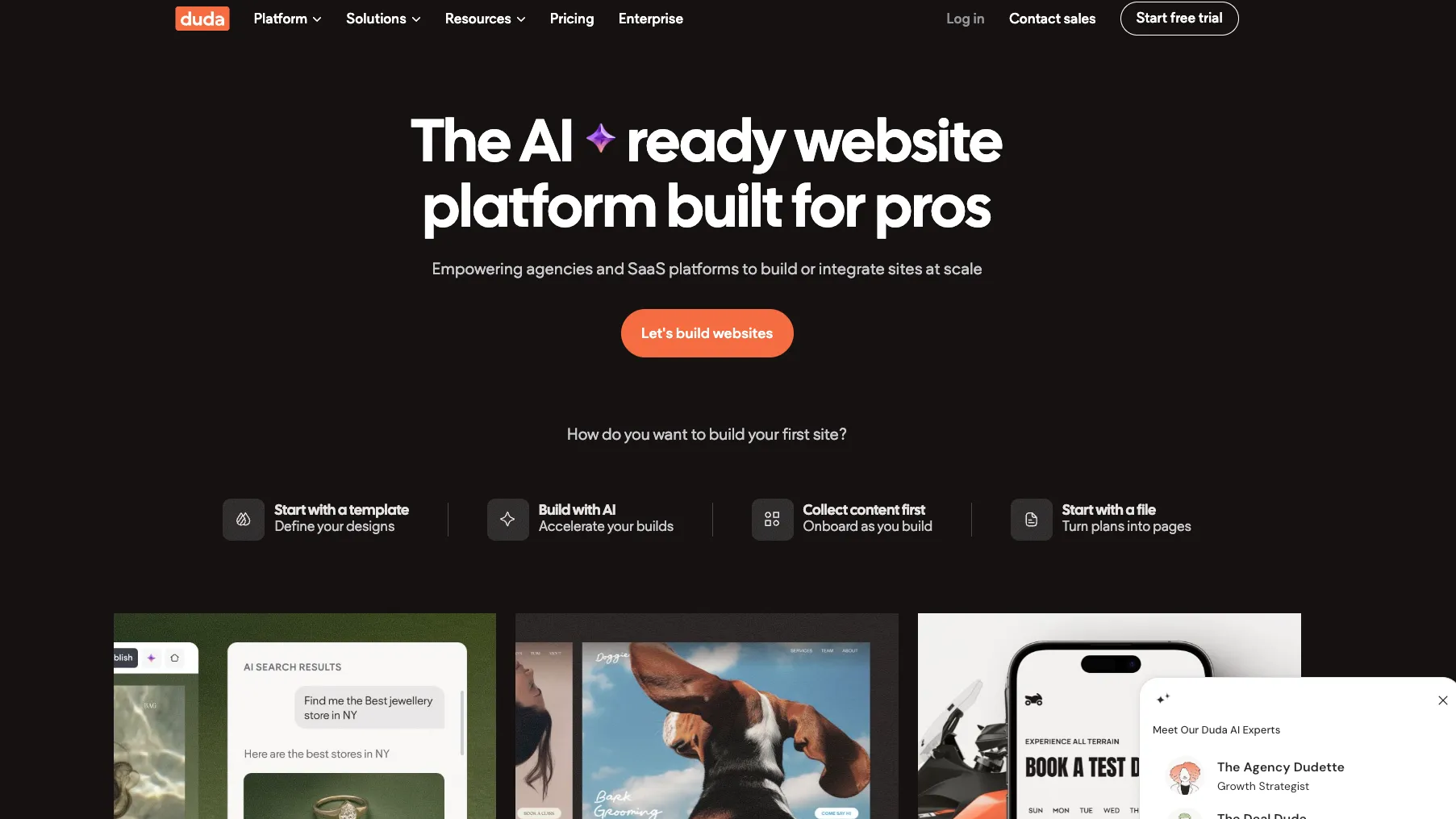
Duda is a professional website-building platform positioned between no-code site builders, agency production systems, and API-driven white-label website infrastructure.
Information checked: Jun 30, 2026 ·View sources
Tool details
- Type
- App builders
- Platforms
- Web
- Free plan
- No
- Open source
- No
- Bring your own key
- No
- Local models
- No
Overview
Best for
- Digital agencies building and maintaining client websites
- Freelancers who want reusable templates and faster client delivery
- SaaS platforms embedding website creation into their own product
- Hosting, POS, and local business platforms that need white-label site building
- Teams that want AI-assisted content, SEO, onboarding, and site operations
Strengths
- Strong fit for agencies managing many client websites.
- Combines no-code editing with APIs, widgets, and MCP automation.
- White-label workflows are more central than in many general website builders.
- AI tools are designed around real agency production workflows, not only one-off prompt generation.
- Useful for SaaS and hosting companies that want embedded website creation.
Limitations & trade-offs
- Developers looking for a local AI code editor like Cursor or Windsurf
- Teams that need full source-code ownership and self-hosted deployment
- Single personal sites where a simpler free builder is enough
- Complex custom web applications that require backend logic outside a website-builder model
- Workflows that cannot accept hosted SaaS infrastructure
- Not a code-first IDE or full-stack app generation environment.
- Free plan is not publicly positioned as a permanent plan; Duda mainly offers a free trial.
- Pricing can rise as additional sites, eCommerce, bookings, or white-label needs grow.
- Deep customization still depends on Duda’s hosted platform and editor model.
- AI and MCP features should be reviewed carefully because they can affect live site content and account settings.
Get started
Pricing & usage limits
Official pricingFrom $19
Entry plan for one website; $25 month-to-month.
Adds team-oriented workflows; $39 month-to-month.
Includes four sites and agency-oriented scaling tools; $69 month-to-month.
White-label client delivery for agencies and platform partners; $199 month-to-month.
Custom scale, migration, API, support, and enterprise requirements.
Pricing checked: Jun 30, 2026 · Subscription, usage limits, and model costs may be billed separately.
Features & details
AI Site Production
- AI-assisted multi-page website creation
- AI text, SEO metadata, and image alt-text generation
- AI content collection for client onboarding
- Template population with AI-generated business content
Agency Operations
- Team and client permissions
- Client comments and handoff workflows
- Reusable templates, sections, and assets
- White-label editor and customer experience
Developer & Automation
- Partner REST API
- Duda MCP server for AI assistant workflows
- Custom widgets and frontend code access
- Dynamic pages from structured data sources
Publishing & Growth
- AWS-hosted websites
- HTTPS and automatic backups
- SEO and AEO-oriented site tooling
- Native eCommerce, bookings, membership, and app marketplace options
Why Choose Duda?
Duda is best understood as a production platform for professional website delivery, not as a traditional AI IDE. Its strongest use case is helping teams create, manage, and update many client websites through a repeatable workflow: templates, content collection, AI-assisted editing, client permissions, publishing, and ongoing operations.
That makes Duda different from prompt-to-app builders such as Lovable or Bolt.new. Those tools focus on generating application code from prompts. Duda focuses on shipping hosted, editable, business-facing websites where agencies, SaaS platforms, and service providers need control over client access, branding, content, SEO, and repeatable delivery.
Core Workflow
A typical Duda workflow starts with a template, business data, or client content intake. From there, the builder can use AI to populate content, shape page copy, generate SEO fields, and accelerate repetitive production steps. The important distinction is that Duda keeps the website inside a structured editor and hosted platform, rather than handing the user a raw generated codebase.
For developers and platform teams, the workflow can become more automated. Duda’s Partner API supports programmatic site creation and management, while the MCP server allows compatible AI assistants to interact with Duda account and site operations. This is valuable when the team already has customer data in a CRM, POS, marketplace, directory, or SaaS product and wants that data to flow into websites.
Use Cases
Duda is especially relevant for agencies that sell websites as a repeatable service. Instead of rebuilding the same operational stack for every client, teams can standardize the editor, hosting, permissions, templates, and handoff process. This is useful for local business verticals such as restaurants, home services, real estate, clinics, franchises, and multi-location operators.
It also fits SaaS and infrastructure businesses that want to offer websites as an embedded product. A booking platform, POS system, property management tool, or local marketing platform can use Duda as the website layer while keeping the customer experience under its own brand.
Comparison to Alternatives
Compared with Webflow, Duda is generally more focused on agency operations, client management, and large-scale site production. Webflow often appeals to design-led teams that want granular visual control and a broader front-end design culture. Duda is more compelling when the operational burden of managing many client sites matters as much as design flexibility.
Compared with WordPress, Duda reduces plugin maintenance, hosting configuration, update risk, and security overhead by keeping sites in a managed SaaS environment. The tradeoff is that WordPress remains more open, portable, and extensible for teams that need full code and infrastructure control.
Compared with Wix Studio or Squarespace, Duda’s differentiation is its agency and white-label orientation. A single-site owner may find simpler website builders sufficient, but teams selling websites as a service may value Duda’s client handoff, permissions, API, and automation options more.
Best Configuration
For a small team evaluating Duda, the practical starting point is to map the expected number of client sites, how much client access is needed, whether white labeling is part of the offer, and whether API or MCP automation will actually be used. The right plan depends less on a single website and more on the operating model around many websites.
Teams planning to use Duda as part of a SaaS or embedded website offering should validate API access, authentication flow, content model, domain handling, template strategy, and support responsibilities early. Duda can serve as a strong website layer, but it still requires thoughtful product design when it becomes part of another platform.
Migration Notes
Migrating into Duda is easiest when the goal is to standardize a repeatable website format rather than perfectly reproduce every detail of an old site. For one or two sites, rebuilding with imported content can be reasonable. For dozens, hundreds, or thousands of websites, the migration plan should be treated as an operations project involving templates, content mapping, redirects, SEO checks, client approvals, and publishing workflows.
The most important migration question is whether Duda will become the long-term system of record for website content. If customer data already lives in another platform, teams should decide what stays external, what gets synced, and what editors are allowed to change manually inside Duda.
Model support & data privacy
Supported models
- OpenAI
Privacy & data handling
Duda is a hosted SaaS platform; teams should review Duda’s privacy, GDPR, AI, and MCP documentation before connecting customer data, client accounts, or third-party AI assistants. Duda’s MCP documentation notes that AI-assisted actions can make permanent site or account changes, so human review is important.
Guides, reviews & fixes
View allNo published guides yet. Start with the official documentation above.
Product updates
No verified product updates listed yet. Follow this tool to see new relevant content in Saved.
See the content timelineAlternatives
Sources & verification
Verification dates record when this directory checked the information. Product release dates appear separately above.
Directory revision history
Created directory entry and verified official pricing, AI Stack, API, and MCP documentation.