

Contentful
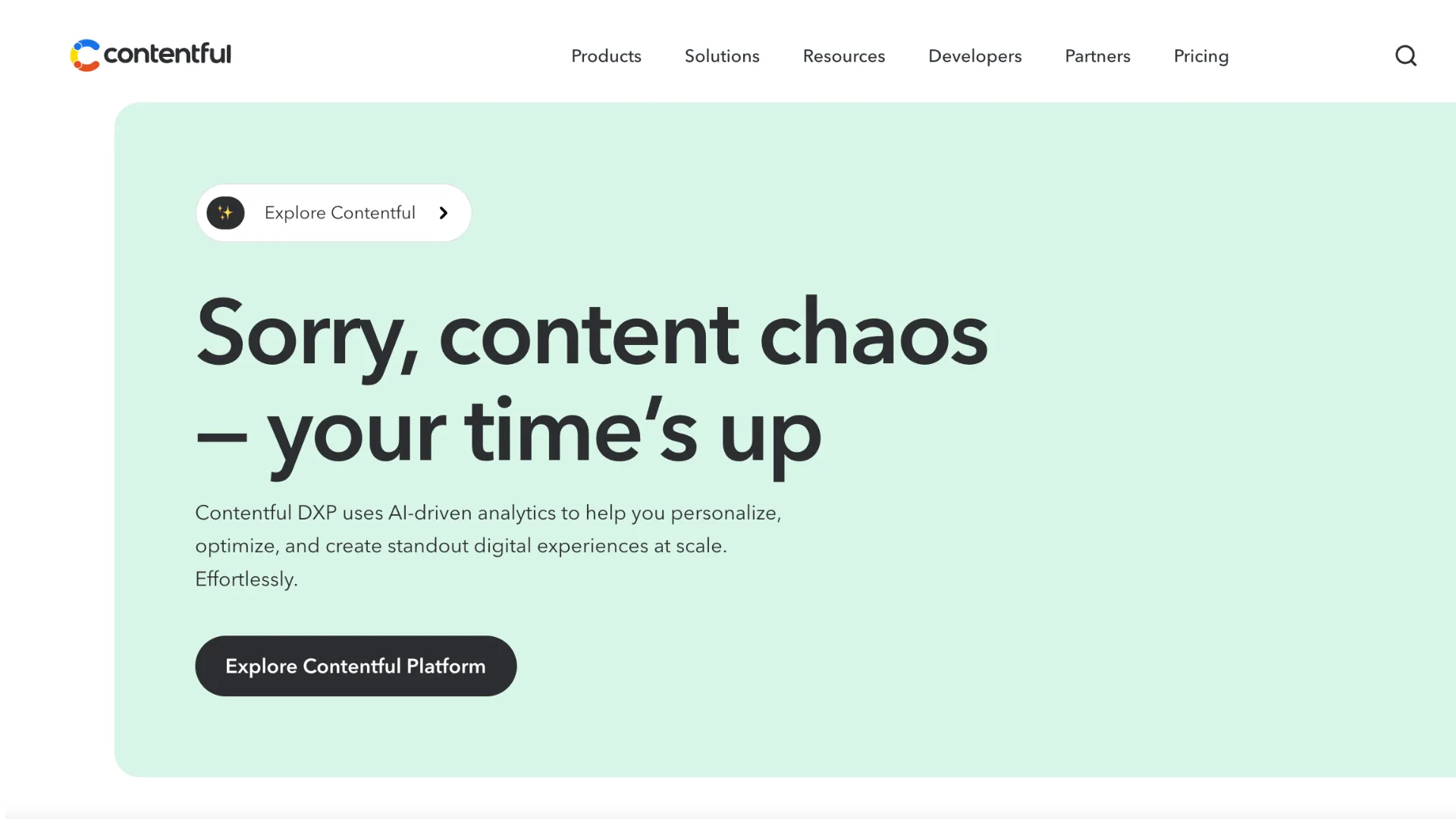
Contentful is a composable, API-first content platform positioned between headless CMS infrastructure and enterprise digital experience management.
Information checked: Jun 26, 2026 ·View sources
Tool details
- Type
- Developer workflows
- Platforms
- Browser, Web API, JavaScript, TypeScript, Node.js, React, Next.js, REST, GraphQL
- Free plan
- Yes
- Open source
- No
- Bring your own key
- No
- Local models
- No
Overview
Best for
- Marketing sites and product experiences that need structured content
- Teams building with Next.js, React, mobile apps, or composable commerce stacks
- Organizations managing content across multiple brands, regions, locales, or channels
- Developer-led teams that want APIs and webhooks instead of a template-bound CMS
- Enterprises that need content governance, personalization, and AI-assisted editorial operations
Strengths
- Strong fit for API-first websites, apps, and multi-channel content delivery.
- Mature ecosystem with documentation, SDKs, marketplace apps, and partner integrations.
- Good separation between content modeling, editorial work, and frontend implementation.
- Enterprise controls support larger brand, locale, and governance requirements.
- AI features are embedded in content workflows rather than bolted onto a generic editor.
Limitations & trade-offs
- Developers looking for an AI code editor, CLI coding agent, or PR automation tool
- Small hobby projects that need a low-cost production CMS
- Teams that prefer a fully open-source, self-hosted CMS stack
- Projects where content is simple enough to live in Markdown, a database table, or a static file
- Organizations that cannot commit to content modeling and editorial governance upfront
- Not an AI IDE or coding agent; it does not generate application code or manage pull requests.
- Lite starts at $300/month, so production use can be expensive for small projects.
- Advanced AI, personalization, Studio, and enterprise governance are mainly sales-led.
- Content modeling decisions can be hard to reverse after editors and frontends depend on them.
- Teams still need frontend, deployment, and analytics infrastructure around the CMS.
Get started
Pricing & usage limits
Official pricingFree tier · From $300
For learning and exploring Contentful; includes 10 users, 100K API calls/month, 50 GB CDN bandwidth/month, and one Starter Space.
For smaller businesses managing one project; includes 20 users, 1M API calls/month, 100 GB CDN bandwidth/month, collaboration, and scheduled publishing.
For scaled digital experiences with custom users, roles, locales, security, governance, support, uptime SLA, and access to enterprise add-ons such as Personalization, Studio, and AI Actions.
Pricing checked: Jun 26, 2026 · Subscription, usage limits, and model costs may be billed separately.
Features & details
Structured Content Platform
- Reusable content models for pages, campaigns, products, and multi-channel experiences
- Spaces and environments for separating projects, brands, releases, and staging workflows
- Localization and governance controls for regional or multi-language content operations
Developer APIs
- REST and GraphQL APIs for content delivery, preview, management, and automation
- SDKs and documentation for integrating Contentful into modern web and app stacks
- Webhooks and automation patterns for builds, deployments, and publishing workflows
Editorial Workflow
- Browser-based authoring interface for non-technical content teams
- Comments, tasks, scheduled publishing, and live collaboration on paid plans
- Role-based permissions and publishing controls for larger teams
Extensibility & AI
- App Framework for custom editor extensions, field editors, and full-page apps
- Marketplace integrations for commerce, DAM, analytics, localization, and collaboration tools
- AI Actions for generating, refining, translating, and optimizing content inside editorial workflows
Why Choose Contentful for Developer Workflows?
Contentful is most useful when content needs to behave like product infrastructure rather than a set of static pages. Developers define reusable content models, editors work in a browser UI, and applications consume the result through APIs. That separation is the main reason Contentful remains relevant for modern frontend teams: the CMS does not dictate the rendering layer, deployment target, or framework.
For AI and developer-tool directories, the important distinction is that Contentful is not a coding assistant. Its AI value is closer to content operations: generating draft copy, translating entries, improving editorial quality, and helping teams maintain brand consistency. In practice, it complements AI IDEs by giving generated or human-written applications a governed source of structured content.
Core Workflow
A typical implementation starts with content modeling. Teams define content types, fields, validations, references, localization rules, and environment strategy before connecting frontend applications. This step is more strategic than it looks: a clean model lets developers reuse content across landing pages, product pages, apps, documentation, and campaigns without duplicating logic.
After the model is stable, developers connect delivery, preview, and management APIs to the frontend or backend stack. Editors then create entries, manage assets, request changes, preview releases, and publish content without waiting for code deploys. For teams using static or hybrid frameworks, webhooks can trigger builds or cache invalidation when content changes.
Use Cases
Contentful fits teams building content-heavy websites, localization-heavy marketing systems, composable commerce experiences, product education hubs, campaign microsites, knowledge bases, and mobile content backends. It is especially valuable when content needs to be reused across multiple surfaces with different layouts.
The platform is less compelling when a project only needs a simple blog or a handful of marketing pages. In those cases, Markdown, a database-backed admin panel, WordPress, or a lightweight CMS may be easier to maintain. Contentful becomes more attractive once multiple roles, locales, content types, preview flows, and integration points enter the picture.
Comparison to Alternatives
Compared with Sanity, Contentful feels more enterprise-platform oriented, while Sanity often appeals to teams that want highly customizable editing experiences and developer-defined content studios. Compared with Strapi, Contentful removes self-hosting burden but gives up the infrastructure control and open-source economics that some teams prefer.
Compared with visual builders such as Builder.io or Storyblok, Contentful places more emphasis on structured content and API delivery than drag-and-drop page assembly. That can be a strength for design-system-driven organizations, but a limitation for marketing teams that expect full visual page control without developer involvement.
Best Configuration
For a serious production setup, treat Contentful as part of a broader content platform architecture. Keep a clear environment strategy for development, staging, and production. Define naming conventions for content types, references, assets, tags, and locales before the editorial team scales usage. Use preview environments early so editors can validate changes in the real frontend rather than only inside the CMS.
A strong setup also keeps content and presentation separate. Avoid encoding one-off page layout assumptions directly into content models unless those assumptions are stable. For component-driven frontends, map content models to design-system components with a documented contract between editors and developers.
Migration Notes
Migrating into Contentful is usually less about moving text and more about redesigning content structure. Legacy CMS exports often contain HTML blobs, page-specific fields, duplicated assets, and inconsistent taxonomy. The best migration path is to normalize content first, then import entries through scripts or APIs, and only then connect the frontend.
Teams leaving Contentful should plan just as carefully. Exporting entries is possible, but the receiving system must understand references, locales, assets, rich text, and model relationships. The longer a team has used Contentful-specific modeling patterns, the more important it becomes to document model intent before migration.
Practical Tradeoffs
Contentful rewards teams that think in systems: content schemas, governance, preview states, automation, and reusable delivery. It can feel heavyweight when a project only needs quick pages. The decision is less about whether Contentful is powerful and more about whether the organization has enough content complexity to justify a structured platform.
For AI-enabled workflows, the safest expectation is incremental acceleration rather than autonomous publishing. AI Actions can reduce repetitive editorial work, but human review, permissions, brand rules, and publishing controls still matter. That makes Contentful a better match for governed content operations than for teams looking for a hands-off AI website generator.
Model support & data privacy
Privacy & data handling
Contentful is a hosted SaaS platform, so content, assets, user activity, and API usage are handled inside Contentful's cloud service. Enterprise security materials mention SOC 2 Type 2, ISO 27001, SAML SSO, governance controls, and EU data residency options; teams using AI Actions should still review whether drafts, brand guidelines, and regulated content are allowed in AI-assisted workflows.
Guides, reviews & fixes
View allNo published guides yet. Start with the official documentation above.
Product updates
No verified product updates listed yet. Follow this tool to see new relevant content in Saved.
See the content timelineAlternatives
Sources & verification
Verification dates record when this directory checked the information. Product release dates appear separately above.
Directory revision history
Checked public pricing, product positioning, AI Actions, developer documentation, and enterprise security notes.
Salesforce announced a definitive agreement to acquire Contentful, expected to close in Salesforce fiscal Q3 2027 subject to closing conditions.