 EinoEino is an open-source Go framework for building production-oriented LLM applications, agents, and orchestrated AI workflows.
LangChainGo
The Go ecosystem’s practical LangChain-style toolkit for teams that want agent and retrieval components in a compiled, concurrency-friendly language.
Information checked: Aug 14, 2026 ·View sources
Tool details
- Type
- Developer workflows
- Platforms
- Go, Local models, Hosted model APIs
- Free plan
- Yes
- Open source
- Yes
- Bring your own key
- Yes
- Local models
- Yes
Overview
Best for
- Go-based agent services
- RAG in Go applications
- Tool calling and chains
- Teams standardizing on compiled services
- Multi-provider LLM integration
Strengths
- Fits teams whose production services are already written in Go
- Broad set of familiar agent, chain, retrieval, and tool abstractions
- MIT-licensed and community maintained
- Compiled deployments and Go concurrency can suit high-throughput services
Limitations & trade-offs
- Teams needing the newest Python-first integrations immediately
- No-code agent creation
- Durable workflow execution without extra infrastructure
- Very small applications that only need one model call
- Community implementation may lag the largest Python and JavaScript agent ecosystems
- Abstraction breadth can add complexity for simple model calls
- Durability, evaluation, and observability require additional systems
- Provider integrations vary in depth and update cadence
Get started
Pricing & usage limits
Free tier available
Open Source$0
LangChainGo is distributed under the MIT license.
Models and vector storesProvider rates
Connected inference, embeddings, databases, and observability services are billed separately.
OperationsSelf-managed
Application deployment, state, scaling, and monitoring remain the team’s responsibility.
Pricing checked: Aug 14, 2026 · Subscription, usage limits, and model costs may be billed separately.
Features & details
Agent and chain primitives
- Compose chains and prompts
- Build tool-using agents
- Manage messages, memory, callbacks, and structured application flow
Retrieval and data
- Connect document loaders and text splitters
- Use embeddings, retrievers, and vector stores
- Build retrieval-augmented generation services
Go integrations
- Use multiple model providers from Go
- Integrate agents into existing Go services
- Leverage Go concurrency and deployment patterns
LangChainGo Review
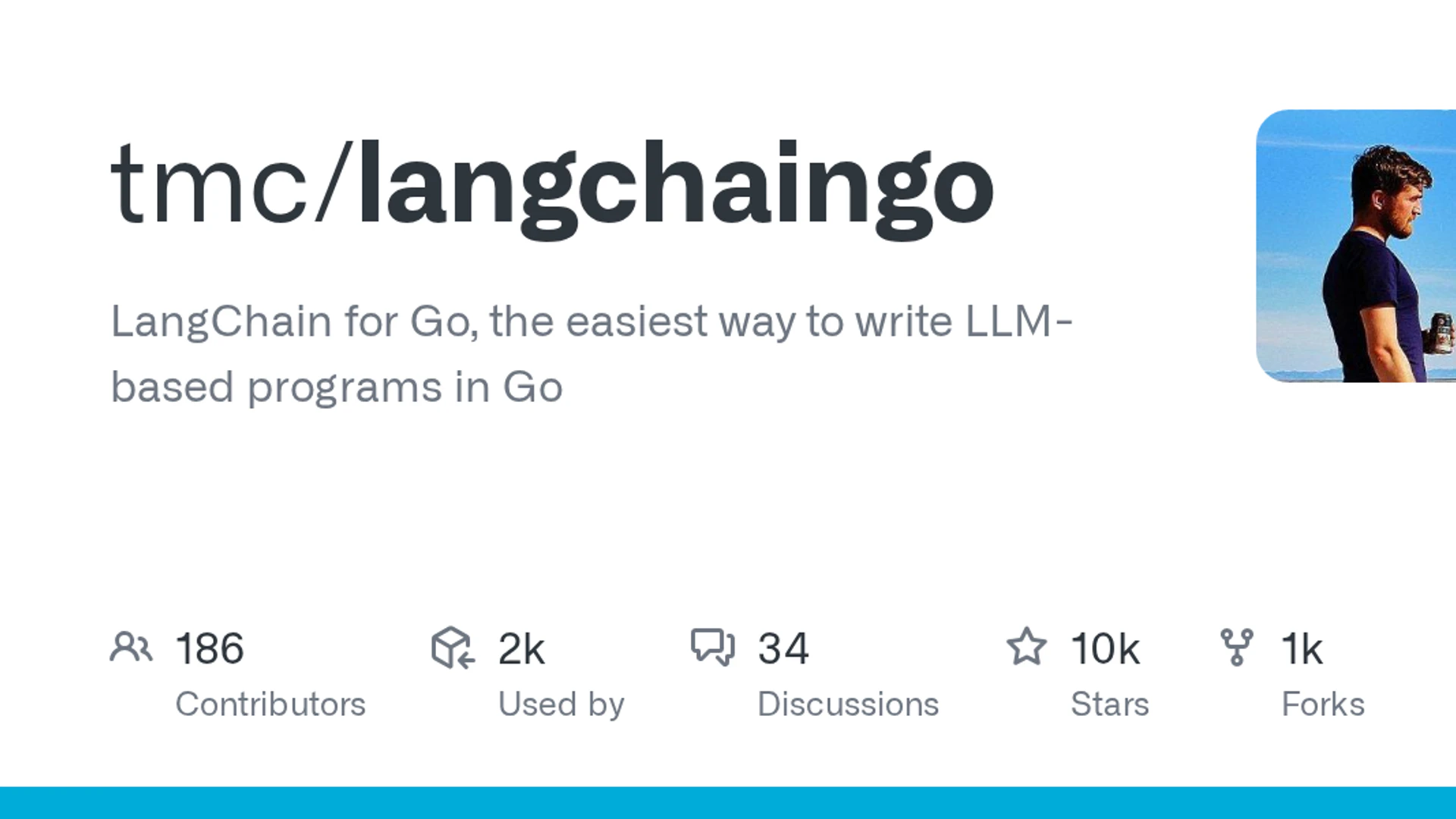
LangChainGo is a community-maintained Go implementation of LangChain concepts for building LLM applications with agents, chains, tools, prompts, memory, retrievers, vector stores, and multiple model providers.
What LangChainGo Is
The Go ecosystem’s practical LangChain-style toolkit for teams that want agent and retrieval components in a compiled, concurrency-friendly language.
Core Capabilities
Agent and chain primitives
- Compose chains and prompts
- Build tool-using agents
- Manage messages, memory, callbacks, and structured application flow
Retrieval and data
- Connect document loaders and text splitters
- Use embeddings, retrievers, and vector stores
- Build retrieval-augmented generation services
Go integrations
- Use multiple model providers from Go
- Integrate agents into existing Go services
- Leverage Go concurrency and deployment patterns
Best Use Cases
- Go-based agent services
- RAG in Go applications
- Tool calling and chains
- Teams standardizing on compiled services
- Multi-provider LLM integration
Pricing
- Open Source: $0 — LangChainGo is distributed under the MIT license.
- Models and vector stores: Provider rates — Connected inference, embeddings, databases, and observability services are billed separately.
- Operations: Self-managed — Application deployment, state, scaling, and monitoring remain the team’s responsibility.
Pricing and availability can change. These details were checked against official sources on 2026-08-14.
Advantages
- Fits teams whose production services are already written in Go
- Broad set of familiar agent, chain, retrieval, and tool abstractions
- MIT-licensed and community maintained
- Compiled deployments and Go concurrency can suit high-throughput services
Limitations
- Community implementation may lag the largest Python and JavaScript agent ecosystems
- Abstraction breadth can add complexity for simple model calls
- Durability, evaluation, and observability require additional systems
- Provider integrations vary in depth and update cadence
Privacy and Operational Notes
LangChainGo runs inside your service, so data handling depends on connected models, vector stores, tools, and logging. Use scoped credentials, filter tool access, and avoid persisting sensitive prompts without an explicit policy.
LangChainGo Alternatives
The most relevant comparison set is Eino, Pydantic AI, Agent Development Kit (ADK). Compare products by execution model, integration surface, security controls, deployment model, maintenance burden, and total usage cost.
Verdict
LangChainGo is a reasonable choice for Go teams that need recognizable agent and RAG building blocks without moving core application logic into Python or JavaScript.
Official Sources
Model support & data privacy
Privacy & data handling
LangChainGo runs inside your service, so data handling depends on connected models, vector stores, tools, and logging. Use scoped credentials, filter tool access, and avoid persisting sensitive prompts without an explicit policy.
Guides, reviews & fixes
No published guides yet. Start with the official documentation above.
Product updates
No verified product updates listed yet. Follow this tool to see new relevant content in Saved.
See the content timelineAlternatives
EinoEino is an open-source Go framework for building production-oriented LLM applications, agents, and orchestrated AI workflows. Pydantic AIA type-safe, provider-agnostic Python framework for production agents and structured LLM workflows.
 Agent Development Kit (ADK)Google’s open-source, deployment-flexible framework for production agents and multi-agent workflows.
Sources & verification
Verification dates record when this directory checked the information. Product release dates appear separately above.
Directory revision history
Added as the relevant Go-native agent framework from the missing-tool list.