
On This Page8 sections
Key Takeaways
- Hugging Face has officially disabled Audn AI's
penclaw-GLM-5.3-abliterated-for-offensive-cyberrepository. The page now states that access has been disabled because the content infringes Hugging Face's Content Policy. - There is no public Hugging Face explanation identifying the exact trigger. Audn says the Hugging Face content team removed earlier versions and that it did not understand why. A community member suggested the
offensive cybernaming may have contributed, but that remains speculation rather than an official reason. - The strongest clue is the combination of framing and capability, not abliteration alone. Before the takedown, the repository said it planned to unrestrict, ablate, abliterate or uncensor GLM-5.3 and then fine-tune it for "offensive black-box cyber capabilities."
- The repository appears to have been moderated before full GLM-5.3 weights were present in the indexed snapshot. A cached file listing showed only
.gitattributesand a 384-byteREADME.md, while the card said GLM-5.3 weights would be available in two weeks. - Audn's account was not broadly removed, and a renamed replacement remains available. The current
penclaw-GLM-5.3-abliteratedmodel explicitly describes a weight edit that removes refusal behavior, but its intended-use language now emphasizes authorized red-team, safety-research and evaluation use. - This does not look like a platform-wide ban on uncensored or abliterated models. Hugging Face search currently returns thousands of models matching
abliterated, including cyber-focused and explicitly OffSec-branded examples.
What Happened to the Offensive-Cyber GLM-5.3 Repository?
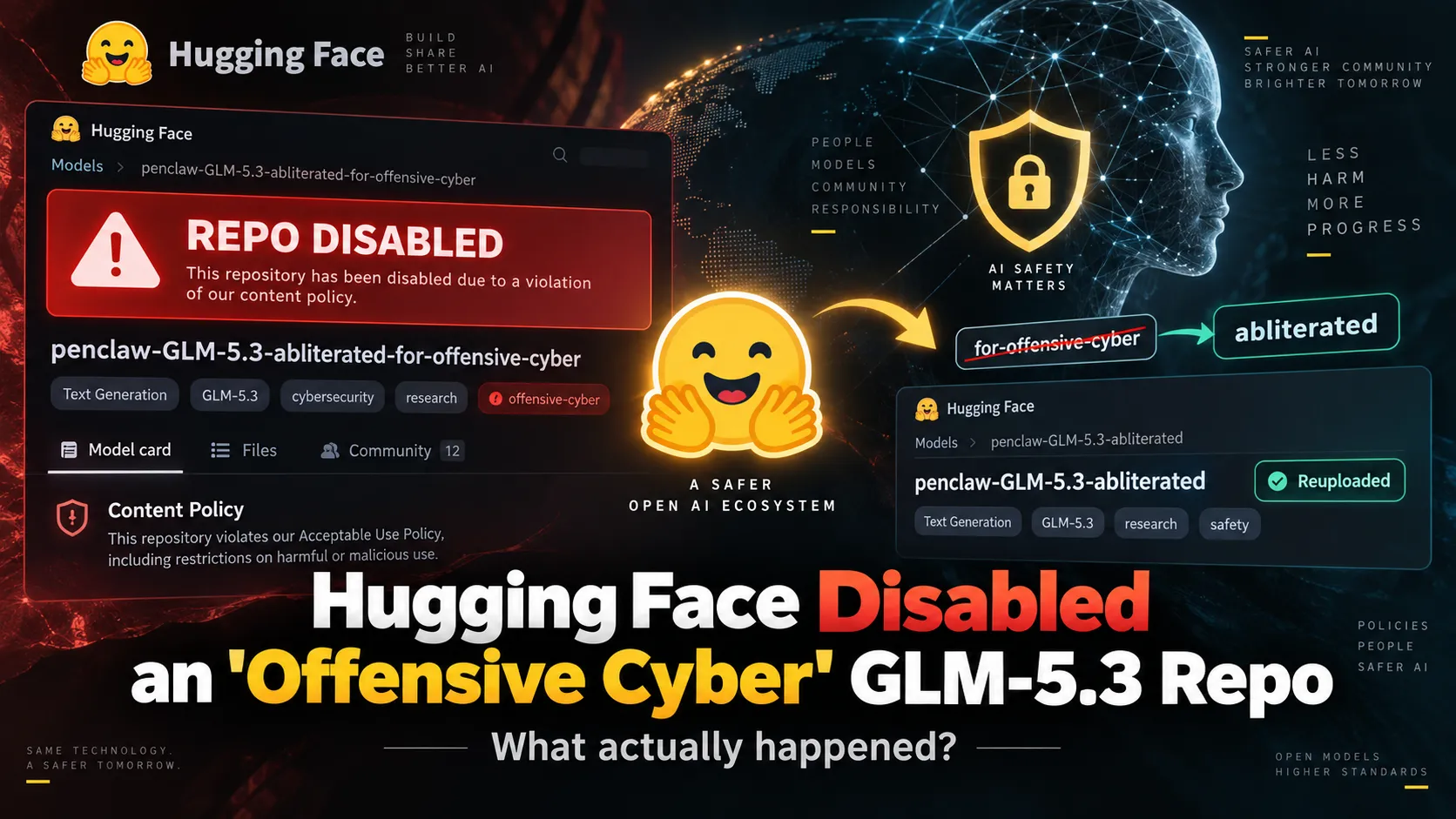
A Hugging Face repository from Audn AI named penclaw-GLM-5.3-abliterated-for-offensive-cyber has been disabled by the platform.
The status is unusually explicit. The repository page does not merely return a missing-page error or indicate that the owner deleted it. Instead, Hugging Face displays:
"Access to this model has been disabled"
and states that the content infringes its Content Policy.
That distinction matters. It confirms that this was a platform moderation action against the repository rather than a routine rename, owner deletion or accidental disappearance.
What Hugging Face has not published is equally important: there is currently no public enforcement note explaining the exact content, model behavior or policy clause that triggered the action.
That makes the event verifiable, while the precise reason remains unresolved.
What the Original Model Card Actually Said
Before the repository was disabled, search-indexed copies preserved a short but unusually direct description.
The model card said GLM-5.3 weights would become publicly available in roughly two weeks. It then stated that Audn planned to:
- unrestrict the model;
- derisk or ablate it;
- abliterate or uncensor it;
- and fine-tune it for "offensive black-box cyber capabilities."
That wording is more important than the label abliterated by itself.
Abliteration generally refers to modifying model weights so the model is less likely to activate refusal behavior. Audn's replacement repository describes its method as a direct weight edit that removes the model's refusal direction from residual-writing weights without conventional fine-tuning or retraining.
The old repository therefore combined two separate ideas:
- removing or weakening refusal behavior, and
- explicitly optimizing the resulting model for offensive cyber capability.
That combination creates a substantially different moderation context from a generic uncensored role-play model or a research repository studying refusal mechanisms.
The Most Important Detail: The Full Model May Not Have Been There Yet
One of the most revealing pieces of evidence is the cached file tree.
An indexed snapshot of the original repository showed only two files:
.gitattributes— 1.52 kBREADME.md— 384 bytes
The same snapshot described the repository as gated, while the README said that GLM-5.3 model weights would be available in two weeks.
This does not prove that Hugging Face acted solely because of the repository name or README. The indexed snapshot is only a point-in-time view, and additional files could theoretically have appeared later.
However, it creates an important possibility: the moderation decision may have occurred before a complete modified GLM-5.3 checkpoint was publicly hosted in that repository.
If so, Hugging Face would not have needed to establish harmful model behavior by running the model. The repository's declared purpose and presentation could have been sufficient to create a policy issue.
That is arguably more significant than a simple model takedown because it suggests that model hosting moderation can operate at the level of stated intent, documentation and distribution context, not only at the level of weights.
What Hugging Face's Content Policy Says
Hugging Face's Content Policy contains a section covering Platform Abuse, Security Violations and Spam.
Among the restricted categories are content designed to disrupt, damage or gain unauthorized access to systems or devices, as well as content that attempts to transmit or generate malicious code such as malware, trojans or viruses.
That language is directly relevant to the interpretation of a repository openly framed around offensive cyber capability.
However, an important evidentiary boundary remains:
Hugging Face has not publicly said that this specific repository was disabled under that specific subsection.
The repository only says that it infringes the Content Policy. Connecting it specifically to the security-violations section is a strong policy-based interpretation, not a disclosed enforcement rationale.
What Audn AI Said After the Removal
The most useful first-party comment from Audn appears in a discussion attached to the replacement model.
When asked about previously released iterations, the repository owner said those versions had weaker coherence and compliance results and added that the "huggingface content team removed" them. Audn also said it did not understand why and did not want to trigger the same problem again.
A community member then suggested that Hugging Face may have reacted to the previous offensive cyber naming.
That comment is frequently the basis for the theory that the repository name caused the removal.
But it should not be upgraded into a confirmed fact.
The evidence supports three separate statements:
- Confirmed: Hugging Face disabled the old repository for a Content Policy violation.
- Confirmed at the publisher level: Audn says Hugging Face's content team removed earlier versions.
- Unconfirmed: the
offensive cyberphrase itself was the decisive trigger.
That distinction is essential for accurate reporting.
Why the Name Alone Probably Does Not Explain Everything
A simple explanation would be that Hugging Face bans models whose names openly reference offensive security.
Current platform data makes that explanation difficult to sustain.
Hugging Face's model search currently shows about 130 models under the offensive-security filter. Visible examples include cyber-oriented models and repositories with names such as CyberStrike-OffSec-35B-abliterated.
A separate search for abliterated returns roughly 7,970 models at the time of writing. Results include Huihui-CyberStrike-OffSec-35B-abliterated, BaronLLM_Offensive_Security-abliterated-GGUF and multiple abliterated GLM-5.3 derivatives. These counts are dynamic and will change as repositories are added or removed.
This gives two important signals:
- Hugging Face is not broadly prohibiting abliteration.
- Explicit cyber or OffSec terminology is not automatically sufficient for removal.
The more plausible explanation is therefore contextual: the original Audn repository paired refusal removal with an unusually explicit statement that the model would be optimized for offensive black-box cyber capability.
In other words, the issue may be less about one forbidden keyword and more about the repository's combined capability-risk framing.
Why GLM-5.3 Makes This Case More Sensitive
The base model is also relevant.
Z.ai's official GLM-5.3 model card includes a section titled "Emergent Cyber Capability." It says cyber capability developed faster than expected during post-training, describes GLM-5.3 as state of the art on CyberGym for vulnerability discovery, and says the model more than doubles GLM-5.2 on exploitation benchmarks further along the exploitation chain.
That creates a notably different risk profile from taking a weak general-purpose model and merely removing refusals.
The original Audn proposition effectively combined:
a strong open-weight model with documented cyber capability
weight-level refusal removal
an explicitly offensive cyber objective
That does not prove harmful use, nor does it establish Hugging Face's internal reasoning. But it explains why this repository could attract more scrutiny than thousands of ordinary abliterated models.
For technically accurate coverage, GLM-5.3 is also better described as an open-weight model rather than simply "open source." Z.ai itself uses open-weights terminology, and the repository lists a dedicated glm-5.3 license rather than a conventional permissive software license such as Apache-2.0.
What Changed in the Reuploaded Version?
Audn later published penclaw-GLM-5.3-abliterated, removing for-offensive-cyber from the repository name.
The replacement is not presented as a return to a strongly refusing model.
Its model card says Warlock is a direct weight edit that removes refusal behavior while attempting to preserve reasoning, knowledge and fluency. Audn reports 92.5% non-refusal and 82.5% delivery on its own refusal benchmark. Those figures are publisher-reported benchmark results rather than independent third-party measurements.
The most striking change is the intended-use language.
The current card says the model is intended for:
- authorized red-team work;
- safety research;
- evaluation.
It also explicitly places responsibility for compliant use on users.
That creates a clear before-and-after contrast.
| Original repository | Replacement repository |
|---|---|
penclaw-GLM-5.3-abliterated-for-offensive-cyber | penclaw-GLM-5.3-abliterated |
| Planned refusal removal | Explicit refusal-removing weight edit |
| Planned fine-tuning for offensive black-box cyber capability | Authorized red-team, safety-research and evaluation framing |
| Disabled for Content Policy infringement | Available at the time of writing |
The technical direction did not disappear. The distribution framing changed dramatically.
That does not prove Hugging Face privately instructed Audn to rewrite the card. There is no public evidence of such an instruction. But the surviving replacement demonstrates why framing and declared use are central to understanding the incident.
Is Hugging Face Now Banning Uncensored Models?
The available evidence says no.
Thousands of abliterated models remain searchable on Hugging Face, including many whose names openly advertise uncensored behavior.
The platform's Content Policy is also framed around restricted content and harmful or abusive use cases rather than a blanket prohibition on safety-modified model weights.
A more defensible interpretation is:
Hugging Face continues to host abliterated and uncensored models, but a repository can still cross a moderation boundary when its documentation, intended use and capability profile point directly toward activities covered by the platform's restricted-content rules.
That interpretation fits the evidence without claiming knowledge of Hugging Face's undisclosed moderation process.
What This Case Says About AI Model Hosting
The incident highlights a broader shift in open-model governance.
Model-hosting platforms increasingly have to moderate more than binary files. A repository can communicate risk through several layers:
- repository name;
- model card;
- tags;
- declared intended use;
- benchmark selection;
- fine-tuning objective;
- gating conditions;
- linked tools or deployment instructions.
For advanced models, those contextual signals can matter as much as whether the underlying weights are technically downloadable.
This is especially relevant to cybersecurity models because many legitimate activities and prohibited activities use similar technical capabilities. Vulnerability discovery, exploit analysis and red teaming can be defensive when authorized, while the same capabilities can be used against systems without permission.
The practical boundary is therefore not simply "cybersecurity model versus non-cybersecurity model."
The harder moderation problem is distinguishing:
authorized security research and defensive evaluation
from
content explicitly designed or distributed to facilitate unauthorized compromise or malicious code generation.
Hugging Face's policy language reflects that distinction, even though the company has not disclosed exactly how it applied the policy in Audn's case.
Common Misreadings of the Incident
Several claims circulating around this story go further than the available evidence.
"Hugging Face banned Audn AI."
Not established. The action visible publicly is against the specific repository, while Audn's replacement model and community activity remain available.
"Hugging Face banned GLM-5.3 abliteration."
False as a general claim. Multiple GLM-5.3 abliterated derivatives remain searchable, alongside thousands of other abliterated repositories.
"The words offensive cyber automatically trigger a ban."
Not demonstrated. Other models with offensive-security and OffSec terminology remain hosted.
"Hugging Face confirmed the model was removed because it generated malware."
No public evidence supports that statement. Hugging Face confirms a Content Policy infringement but does not publish a detailed rationale on the disabled page.
"A fully released 753B attack model was removed after Hugging Face tested it."
Also not established. The preserved pre-removal file listing contained only a small README and .gitattributes, and the card said the weights were still forthcoming.
The Bigger Takeaway for Open-Weight Model Publishers
For model publishers, this case is a useful reminder that model documentation is part of the product being moderated.
A technically identical or closely related model can be presented in very different ways:
- as an unrestricted offensive capability;
- as an authorized red-team research artifact;
- as a safety-evaluation model;
- as a refusal-mechanism research experiment.
Those labels do not magically make unsafe behavior acceptable. Platforms can look beyond wording.
But wording also matters because a repository's stated purpose provides evidence about what the publisher intends users to do with the model.
The Audn case illustrates why serious model cards should precisely define:
- authorized use;
- prohibited use;
- evaluation scope;
- safety limitations;
- benchmark methodology;
- who is responsible for deployment controls.
This is not merely compliance language. For dual-use AI, it is part of the technical and operational context needed to understand what is actually being distributed.
Conclusion
The strongest verified version of the story is more nuanced than "Hugging Face got angry and banned an uncensored model."
Hugging Face did disable Audn AI's penclaw-GLM-5.3-abliterated-for-offensive-cyber repository and explicitly marked it as violating the platform's Content Policy.
Before the action, the repository publicly described a plan to remove restrictions from GLM-5.3 and optimize it for offensive black-box cyber capabilities. A cached file tree suggests the indexed repository still contained only a tiny README and .gitattributes, making it possible that moderation occurred before the full modified weights were publicly present.
What remains unknown is the exact enforcement trigger. Hugging Face has not publicly identified one, and Audn itself says it did not understand the reason for the removal.
The surviving replacement makes the contrast especially revealing: refusal removal remains, while the explicit offensive-cyber branding is gone and the intended use is now framed around authorized red teaming, safety research and evaluation.
For researchers tracking open-weight AI, cybersecurity models and platform governance, that is the part worth watching next: not whether Hugging Face bans all uncensored models, but where it draws the line when refusal removal, high cyber capability and explicitly offensive intended use converge.
Continue Reading
More articles connected to the same themes, protocols, and tools.


Referenced Tools
Browse entries that are adjacent to the topics covered in this article.