
On This Page8 sections
Key Takeaways
- Lovable is the better choice for product builders who need a real web app: database, authentication, GitHub workflow, team collaboration, deployable code, and a path to production.
- Manus is the better choice for autonomous work: research, browser operations, slide generation, file-to-output workflows, market analysis, and broad multi-step tasks.
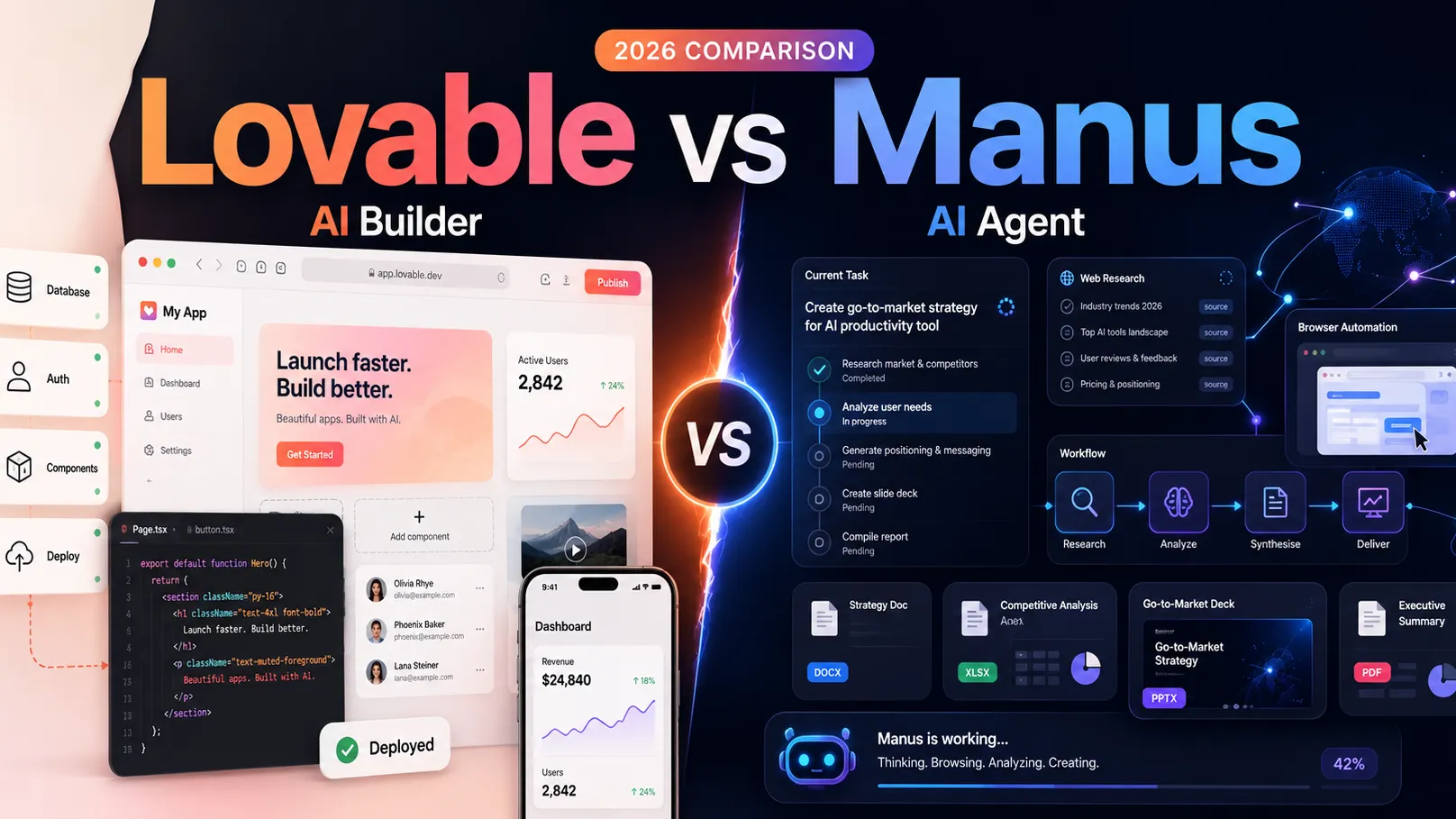
- The biggest difference is not “which AI is smarter.” The real difference is the operating model: Lovable behaves like an AI app-builder workspace, while Manus behaves like an AI agent that can also build websites and complete knowledge-work tasks.
- For SaaS MVPs, dashboards, marketplaces, and internal tools, Lovable is usually safer. Its workflow is closer to a modern engineering process: generated code, GitHub sync, backend options, preview, deployment, and ownership controls.
- For research-driven projects, Manus can be more useful before development begins. It can gather information, structure briefs, process data, produce slides, and automate browser-based workflows before a builder writes the first app prompt.
- Best practical stack: use Manus for research, requirement discovery, competitive analysis, and data preparation; use Lovable for the actual web app build, iteration, GitHub handoff, and production hardening.
Quick Verdict: Lovable vs Manus
Lovable and Manus are often compared because both can turn natural language into working digital products. But they are not perfect substitutes.
Lovable is a specialized AI web app development platform. It is designed for building, iterating on, and deploying full-stack web applications through natural language prompts, with a workflow that supports real code, backend integration, team collaboration, and production deployment.
Manus is a general-purpose AI agent platform. It is designed to complete broader tasks across research, web browsing, website creation, document generation, slide creation, data processing, and multi-step automation.
The simplest decision rule:
- Choose Lovable when the final deliverable is a maintainable web application.
- Choose Manus when the final deliverable is a completed task, such as a research report, a slide deck, a website draft, a browser workflow, or a multi-step business automation.
- Use both when the project starts with uncertainty and ends with software: Manus for discovery, Lovable for implementation.
What Lovable Is Best At
Lovable is built around the app-development lifecycle. It can generate a working application from a prompt, then let teams iterate, connect a backend, add authentication, review code, publish, and move the project into a more traditional engineering workflow.
That matters because many AI builders can produce a nice demo, but production value depends on what happens after the demo:
- Can the code be reviewed?
- Can a developer take over?
- Can backend logic be secured?
- Can the app be deployed on a custom domain?
- Can data, secrets, auth, and infrastructure be managed responsibly?
Lovable is strongest when the answer needs to be yes.
Best Lovable Use Cases
- SaaS MVPs with sign-up, login, dashboards, and billing flows
- Internal tools with admin panels and database-backed workflows
- Marketplace prototypes
- Booking systems
- Customer portals
- AI tools with frontend, backend, and API integration
- SEO-friendly web apps that need rendered public pages
- Projects that need GitHub handoff to developers
What Manus Is Best At
Manus is broader. It is positioned less like an app builder and more like an autonomous agent that can execute tasks across formats and tools.
Its website-building capability can help create web pages and applications from natural language, but the broader value is that Manus can also perform research, operate in a browser, organize information, generate documents, and complete multi-step tasks.
That makes Manus valuable for work that is messy, cross-functional, or research-heavy.
Best Manus Use Cases
- Competitive research and market maps
- Data collection and report generation
- Slide decks and executive summaries
- Browser-based task automation
- Turning files, prompts, or business inputs into websites or documents
- Research-backed landing page drafts
- Multi-step workflows across connected tools
- Early product discovery before committing to an app architecture
Side-by-Side Comparison
| Category | Lovable | Manus |
|---|---|---|
| Core identity | AI web app builder | Autonomous AI agent |
| Best for | Building maintainable web apps | Completing broad multi-step tasks |
| Strongest output | Full-stack web applications | Research, workflows, slides, websites, automation |
| Development workflow | Prompt → app → iterate → GitHub → deploy | Goal → autonomous execution → deliverable |
| Backend | Built-in backend options, Supabase-style workflows, APIs | Web app backend capabilities plus broader task execution |
| Code ownership | GitHub sync, code export, external deployment path | Code export and no-lock-in style workflow for generated apps |
| Engineering handoff | Stronger | Weaker for traditional app teams |
| Research ability | Useful but secondary | Core strength |
| Browser automation | Not the main use case | Major use case |
| Team/governance | Better suited for app teams and product workflows | Better suited for operations, research, and business automation |
| Ideal buyer | Founder, product team, agency, engineering-adjacent builder | Operator, analyst, founder, consultant, business team |
Code Quality and Ownership
For serious app development, the ownership and handoff model is one of the most important differences.
Lovable is stronger when generated code needs to move into a standard engineering workflow. GitHub sync, code review, local development, deployment flexibility, and team collaboration all matter when the project is expected to survive beyond the prototype stage.
Manus can also generate websites and export code, but its main advantage is not traditional software maintainability. Its advantage is autonomous execution: it can gather information, reason across tasks, create assets, and turn broad instructions into finished deliverables.
The practical difference is workflow maturity:
- Lovable is better when developers will inspect, refactor, extend, and maintain the project.
- Manus is better when the generated site is part of a larger autonomous task, such as research-to-landing-page or file-to-website.
- Lovable has a clearer path into Git-based engineering operations.
- Manus has a broader execution surface, but the app-building workflow is less specialized than Lovable’s.
Backend, Database, Auth, and Payments
Lovable is stronger for web applications that need predictable product architecture.
A production web app usually needs more than screens. It needs a stable data model, authentication, authorization, secrets, API integrations, background jobs, storage, logs, and deployment controls. Lovable is built around this type of product workflow.
Manus can be useful for generating full-stack app drafts or simple websites, especially when the app is attached to a broader research or automation task. However, for complex product architecture, Lovable is usually the more focused tool.
The distinction:
- Choose Lovable when backend correctness, data model changes, environment variables, auth policies, and developer handoff are central.
- Choose Manus when the app is one deliverable inside a broader business workflow, especially if the same task also requires research, writing, slides, or browser actions.
Pricing and Credit Model
Both products use credit-based usage models, but the credit economics are different because the work units are different.
Lovable pricing should be evaluated through the lens of app iteration. The key cost driver is how many product-building prompts, backend changes, previews, cloud features, and AI runtime actions the project requires.
Manus pricing should be evaluated through the lens of autonomous execution. The key cost driver is how many research tasks, browser operations, file-processing jobs, code-generation tasks, and multi-step workflows the agent performs.
Pricing Interpretation
- Lovable pricing should be evaluated per product iteration. The key cost driver is how many app-building prompts, backend changes, cloud usage, and AI runtime features the project needs.
- Manus pricing should be evaluated per autonomous workflow. The key cost driver is how many research, browser, file, code, and generation tasks the agent performs.
- Lovable can become expensive when an app keeps running or AI features consume credits.
- Manus can become expensive when broad autonomous tasks run frequently or in parallel.
SEO, Deployment, and Production Readiness
For SEO-sensitive web apps, Lovable has a clearer product-development orientation. It is better suited to projects that require metadata, structured pages, sitemap planning, custom domains, app performance checks, and an ongoing deployment workflow.
Manus can also support website creation and SEO-oriented output, but its advantage is speed and breadth. It is useful when a site needs to be created from research, business context, or file inputs.
Production Verdict
- For SEO landing pages, both can work.
- For SEO pages connected to a larger app, Lovable is usually the stronger choice.
- For research-to-page generation, Manus can be faster.
- For long-term maintenance, Lovable’s GitHub and app lifecycle workflow is more defensible.
Security, Privacy, and Governance
Security is where the difference between “AI demo” and “real application” becomes obvious.
Lovable is better aligned with software governance because app development usually requires roles, access control, secrets handling, backend policies, deployment visibility, and a predictable review workflow.
Manus can be powerful for research and browser automation, but browser access creates a different risk profile. When an AI agent operates inside logged-in sessions or handles private files, teams need clear rules about what data can be processed and which accounts the agent can access.
Security selection should follow the risk profile:
- Use Lovable for apps that store user data, require auth policies, or need an auditable development path.
- Use Manus for research and operations, but be careful when granting browser access to authenticated tools.
- Avoid putting secrets, production credentials, private customer data, or sensitive internal files into either platform unless the workspace settings, plan controls, and data policy are acceptable.
Prompting Workflow: How to Get Better Results
The biggest mistake is using the same prompt style for both tools.
Lovable performs best when the task is broken into product increments:
Build a web app for [target user].

Core screens:
1. Landing page
2. Sign-up and login
3. User dashboard
4. Admin dashboard

Data model:
- users
- projects
- tasks
- payments

Requirements:
- Use server-side rendering where appropriate
- Add responsive layout
- Add clear empty states and error states
- Keep components modular
- Do not add payment logic until the dashboard is stable

First build only the landing page, auth flow, and database schema.
Manus performs best when the goal includes context, constraints, and a desired deliverable:
Research the market for [product category].

Deliverables:
1. A table of 20 competitors
2. Pricing, positioning, traffic channels, and feature gaps
3. A recommended MVP feature set
4. A landing page outline
5. A 10-slide investor-style summary

Constraints:
- Prioritize current public information
- Separate verified facts from assumptions
- Flag missing or uncertain data
- Produce a final decision memo before building anything
Why This Works
- Lovable needs product boundaries. It should not be asked to build everything at once.
- Manus needs task orchestration. It should be told what to research, how to reason, and what final artifacts to produce.
- Both tools benefit from staged execution. Large prompts should define the destination, but execution should happen in smaller steps.
Common Mistakes to Avoid
Mistake 1: Choosing Manus Just Because It Feels More Autonomous
Autonomy is valuable, but it can hide implementation details. If the goal is a maintainable app with a database, user roles, error handling, and future developer ownership, Lovable is usually the safer starting point.
Mistake 2: Choosing Lovable for Pure Research
Lovable can help with planning, but it is not primarily a research agent. If the task is to analyze competitors, read documents, create a brief, and generate slides, Manus is better aligned.
Mistake 3: Building Too Much in One Prompt
Both tools can produce impressive first drafts, but large one-shot prompts often create fragile products. Better results usually come from:
- Defining the data model first
- Building one user flow at a time
- Reviewing generated code or outputs
- Adding auth before payments
- Adding payments before analytics
- Adding SEO after the page structure is stable
Mistake 4: Ignoring Credit Burn
Credits are not just a billing detail. They shape workflow strategy. Long debugging sessions, repeated broad generations, and autonomous tasks can drain credits quickly. Builders should create a short spec first, then execute in narrower steps.
Mistake 5: Treating Generated Code as Production-Ready Without Review
AI-generated apps still need checks for:
- Auth and authorization gaps
- Environment variable exposure
- Database row-level security
- Payment webhook correctness
- Error handling
- Loading states
- Mobile layout
- SEO metadata
- Accessibility
- Logging and monitoring
Which Tool Should Different Users Choose?
Non-Technical Founder
Choose Lovable if the priority is shipping a SaaS MVP, internal tool, or user-facing web app.
Choose Manus if the priority is validating the idea, researching competitors, producing slides, or building a simple research-backed website.
Developer
Choose Lovable for fast scaffolding and GitHub handoff.
Choose Manus for research automation, browser workflows, report generation, and non-code execution tasks.
Agency
Choose Lovable for client web-app prototypes and maintainable handoff.
Choose Manus for discovery, strategy docs, competitive research, proposal decks, and rapid landing page drafts.
SEO Operator
Choose Lovable for structured web apps and content tools that need custom domains, metadata, sitemap workflows, and ongoing iteration.
Choose Manus for keyword research briefs, competitor maps, landing page outlines, and automated research.
Enterprise Team
Lovable is generally stronger for governed app development. Manus is attractive for operational automation, but browser and connector access should be managed carefully.
When to Use Both Together
The most powerful workflow is not Lovable versus Manus. It is Manus before Lovable.
A strong combined workflow looks like this:
-
Manus researches the market
- Competitors
- Pricing models
- Feature gaps
- Search intent
- Landing page angles
- User personas
-
Manus produces a product brief
- MVP scope
- Data model
- User flows
- Copy direction
- SEO requirements
- Risks and assumptions
-
Lovable builds the app
- Screens
- Components
- Auth
- Database
- API integrations
- Deployment
-
Developers review and harden
- GitHub sync
- Security review
- Performance checks
- Production deployment
- Monitoring
This workflow reduces a common AI-building failure: rushing into generation before the product is well defined.
Edge Cases
Can Manus Replace Lovable for Simple Websites?
Yes, especially for landing pages, portfolio sites, simple business websites, and research-backed pages. Manus is often more efficient when the website is only one output inside a broader research or automation workflow.
Can Lovable Replace Manus for Research-Heavy Projects?
Not fully. Lovable can help structure app ideas and product requirements, but Manus is better aligned with broad research, browser operation, and parallel task execution.
Which Is Better for Custom Infrastructure?
Lovable has a clearer external deployment and engineering handoff story. Manus can be useful for exported web projects, but Lovable is more naturally suited to teams that expect developers to extend and maintain the codebase.
Which Is Better for Teams?
Lovable is better for product teams building apps. Manus is better for teams automating knowledge work, research, reports, and business workflows.
Final Recommendation
The correct answer depends on the job to be done:
- Choose Lovable for: SaaS MVPs, dashboards, authenticated apps, internal tools, marketplaces, database-backed products, developer handoff, and production web apps.
- Choose Manus for: autonomous research, browser tasks, file-to-output workflows, slides, market analysis, operational automation, and fast website generation from business context.
- Choose both when building a serious product: Manus for discovery, Lovable for implementation.
Conclusion
Lovable vs Manus is not a simple app-builder comparison. It is a comparison between a specialized AI software-building workspace and a broad autonomous AI agent.
For most builders creating real web applications, Lovable is the more focused and maintainable choice. For operators who need an AI system to research, plan, browse, analyze, and produce deliverables, Manus is more versatile.
The best next step is to define the deliverable before choosing the tool:
- If the deliverable is working software, start with Lovable.
- If the deliverable is completed knowledge work, start with Manus.
- If the deliverable is a validated product, use Manus to clarify the opportunity, then use Lovable to build the app.
Continue Reading
More articles connected to the same themes, protocols, and tools.


Referenced Tools
Browse entries that are adjacent to the topics covered in this article.