
 CursorCursor is an AI coding and cloud development platform that combines a VS Code-based editor, local and cloud agents, CLI workflows, Origin code hosting, repository collaboration, and prompt-to-app creation.
Supermaven
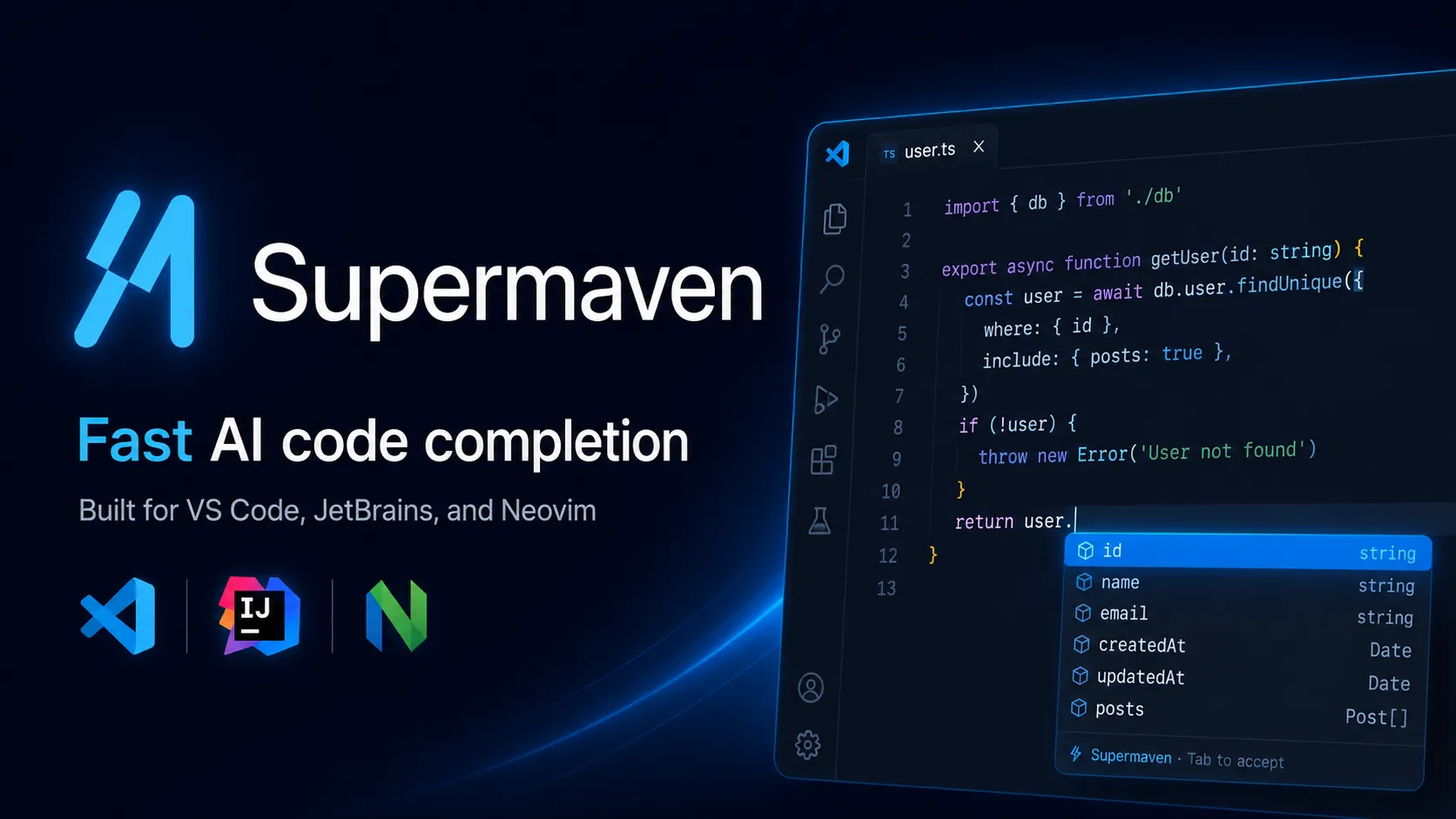
Supermaven is a legacy AI code completion extension known for fast, long-context autocomplete, now largely folded into Cursor after acquisition.
Information checked: Jun 14, 2026 ·View sources
Tool details
- Type
- Editor extensions
- Platforms
- VS Code, JetBrains IDEs, Neovim
- Free plan
- Yes
- Open source
- No
- Bring your own key
- No
- Local models
- No
Overview
Best for
- Existing Supermaven users
- Neovim developers who previously relied on Supermaven autocomplete
- JetBrains users with existing access
- Developers comparing autocomplete-first tools
- Researchers tracking Cursor Tab technology lineage
Strengths
- Very fast inline autocomplete experience.
- Strong fit for developers who wanted AI completion without switching editors.
- Supported VS Code, JetBrains IDEs, and Neovim.
- Long-context design helped suggestions use broader project context.
- Neovim plugin offered practical customization hooks.
Limitations & trade-offs
- New VS Code users choosing a long-term AI coding tool
- Teams that need active standalone vendor roadmap guarantees
- Users who need agentic coding inside Supermaven
- Developers requiring local model execution
- Organizations requiring BYOK or self-hosted inference
- Standalone product is being sunset after the Cursor acquisition.
- New VS Code users are directed toward Cursor instead.
- Agent conversations are no longer supported.
- Not open source as a hosted completion service.
- No local model or BYOK workflow documented for the hosted product.
Get started
Pricing & usage limits
Official pricingFree
Free Tier$0 / month
Legacy free autocomplete tier with fast code suggestions, large-codebase support, and 7-day code data retention.
Pro$10 / month
Legacy paid tier listed with coding-style adaptation, 1M-token context, larger model access, and chat credits.
Team$10 / user/month
Legacy team plan listed with Pro features plus centralized user management and billing.
Sunset status$0
Official sunset notice says existing customers were refunded and existing Neovim/JetBrains customers continue receiving free autocomplete inference.
Pricing checked: Jun 14, 2026 · Subscription, usage limits, and model costs may be billed separately.
Features & details
Code completion focus
- Inline AI suggestions while editing code.
- Designed around low-latency completion rather than full IDE replacement.
- Context-aware suggestions for larger codebases.
Long-context model design
- Promoted as the first code completion tool with a 1M-token context window.
- Uses project context to improve multi-file suggestions.
- Built by Jacob Jackson, creator of Tabnine.
Editor coverage
- Official downloads for VS Code, JetBrains IDEs, and Neovim.
- Official Neovim plugin available on GitHub.
- Neovim plugin supports custom keymaps, ignored filetypes, nvim-cmp integration, and enable/disable commands.
Product status
- Supermaven joined Cursor in November 2024.
- Standalone Supermaven is being sunset after the acquisition.
- Existing VS Code users are recommended by Supermaven to migrate to Cursor.
Chat and agents
- Supermaven Chat previously supported leading hosted models such as GPT-4o, Claude 3.5 Sonnet, and GPT-4.
- Official sunset notice says agent conversations are no longer supported.
- Cursor is now the recommended path for agentic coding workflows from the same team.
Why Choose Supermaven?
Supermaven earned attention by focusing on one developer interaction that matters hundreds of times per day: accepting or rejecting inline completions. Instead of trying to become a full AI IDE, it prioritized speed, project context, and minimal interruption inside the editor developers already used.
That positioning made it especially appealing to developers who wanted an autocomplete upgrade without changing their entire workflow. The major caveat is product status. Supermaven joined Cursor in 2024, and the official sunset notice now frames Cursor as the forward path for VS Code users. For a directory page, Supermaven should be presented as both a notable tool and a legacy product whose core ideas now live more directly inside Cursor Tab.
Core Workflow
The classic Supermaven workflow was lightweight: install the editor extension, keep coding normally, and let the completion model suggest edits inline. The user did not need to start every task with a chat prompt or hand over an issue to an agent. The product fit naturally into the rhythm of writing functions, updating call sites, filling repetitive patterns, and moving through related edits.
For Neovim users, the official plugin made the workflow more configurable than many mainstream AI assistants. Developers could adjust keymaps, ignore filetypes, integrate with nvim-cmp, toggle Supermaven on and off, and inspect logs. That is an important part of Supermaven's appeal: it was not only fast, but also available to editor communities that are sometimes underserved by AI coding products.
Use Cases
Supermaven is most relevant for existing users who still have access to autocomplete inference, teams documenting why they moved to Cursor, and developers comparing the evolution of AI completion tools. It is also useful as a reference point for autocomplete-first UX: low latency, large context, and suggestions that can span more than the current line.
For new adoption, the better question is not whether Supermaven was useful, but whether it is the right long-term dependency. If the workflow is VS Code-based, Cursor is now the more natural successor. If the workflow depends on JetBrains or Neovim, existing Supermaven users may still value continued inference, but new buyers should compare current alternatives carefully before committing.
Comparison to Alternatives
Compared with GitHub Copilot, Supermaven historically felt more focused on speed and long-context autocomplete, while Copilot has broader ecosystem support and a larger active product surface. Compared with Tabnine, Supermaven was more modern in its long-context positioning, while Tabnine remains relevant for teams evaluating enterprise controls and privacy-focused deployment options.
Compared with Continue, Supermaven was less configurable around model routing and open-source customization, but simpler if the goal was just fast inline completion. Compared with Cursor, Supermaven is now best understood as part of the story behind Cursor Tab rather than a direct long-term competitor.
Best Configuration
For remaining Supermaven users, the best setup is conservative: use it primarily for inline autocomplete, keep secrets out of prompts or uploaded context, and avoid depending on discontinued chat or agent workflows. Neovim users should configure keymaps to avoid conflicts with snippets, completion menus, and LSP actions.
Teams evaluating migration should audit how much daily productivity came from simple completions versus deeper chat, agent, or refactoring flows. If Supermaven was mainly used for tab completion, Cursor Tab, GitHub Copilot, Codeium, or Tabnine may be the closest substitutes. If it was used for chat-based code changes, the migration target should be an AI IDE or assistant with active agent support.
Migration Notes
The practical migration path depends on editor choice. VS Code users have the clearest recommendation: move to Cursor if they want the continuation of the Supermaven team's work. JetBrains and Neovim users should test alternatives side by side before removing an existing Supermaven setup, especially if they still receive free autocomplete inference.
During migration, compare suggestion latency, multi-file awareness, keybinding behavior, ignored filetypes, data retention policies, and support for private repositories. Supermaven's history shows that AI completion quality is not only about the model; the editor integration and interaction design are just as important.
Model support & data privacy
Supported models
- GPT-4o
- Claude 3.5 Sonnet
- GPT-4
Privacy & data handling
Supermaven's Code Policy says code uploaded through official extensions is deleted from internal systems within 7 days, is not used to develop products and services, and is not shared except as required by law or necessary to provide the service. The policy also says Supermaven Chat may send uploaded code to third-party model providers such as OpenAI or Anthropic depending on the selected model.
Guides, reviews & fixes
No published guides yet. Start with the official documentation above.
Product updates
No verified product updates listed yet. Follow this tool to see new relevant content in Saved.
See the content timelineAlternatives
CursorCursor is an AI coding and cloud development platform that combines a VS Code-based editor, local and cloud agents, CLI workflows, Origin code hosting, repository collaboration, and prompt-to-app creation. GitHub CopilotGitHub Copilot is a mainstream AI code assistant and developer workflow layer for teams that want AI support inside existing editors, GitHub repositories, pull requests, and terminal workflows.
 WindsurfWindsurf, now transitioning under the Devin Desktop brand, is an AI-native IDE for developers who want coding agents, codebase context, and editor workflows in one desktop environment.
 TabnineTabnine is an enterprise-focused AI coding assistant and agentic platform for organizations that need private, governed, deploy-anywhere AI development workflows.
 ContinueContinue is an open-source AI coding agent and IDE extension ecosystem focused on configurable model access, repository-defined AI checks, and team-controlled coding workflows.
 Sourcegraph CodySourcegraph Cody is an enterprise AI coding assistant focused on codebase-aware chat, code edits, completions, and context retrieval across large multi-repository environments.
 Amazon Q DeveloperAmazon Q Developer remains an AWS developer assistant, but its IDE plugin is now a legacy migration path to Kiro rather than the strategic destination for new IDE deployments.WindsurfWindsurf, now transitioning under the Devin Desktop brand, is an AI-native IDE for developers who want coding agents, codebase context, and editor workflows in one desktop environment.
Sources & verification
Verification dates record when this directory checked the information. Product release dates appear separately above.
Official websiteSupermaven official websiteSupermaven pricingSupermaven download pageSunsetting SupermavenSupermaven joins CursorCursor announcement: Supermaven joins CursorSupermaven Code PolicySupermaven Privacy PolicySupermaven Neovim plugin
Directory revision history
Updated entry to reflect Supermaven's post-acquisition sunset status, legacy pricing page, continued free inference for existing users, editor support, and Cursor migration guidance.